Why Do We Still Suffer?

Wednesday night at my church, our pastor asked an interesting question regarding 1 Peter 1:5. The passage reads, “…who, by God’s power, are being guarded through faith for a salvation ready to be revealed in the last time.” Pastor John asked us how we would respond to someone asking why Christians still suffer if our God is guarding us through faith.

In other words, if God is so powerful and loving and if He truly guards His own, why do His people still deal with sickness, loss, grief, financial ruin, and the like?

My first thought was of Paul’s words in 2 Corinthians 5:1-2: “For we know that if the tent that is our earthly home is destroyed, we have a building from God, a house not made with hands, eternal in the heavens. For in this tent we groan, longing to put on our heavenly dwelling…”

I think of it as the tabernacle/temple/eternity paradigm.

Incredibly, God gave us an illustration of worship in temporary accommodations while in exile when He gave the budding nation of Israel the tabernacle (a specific type of tent) in which to worship Him during their journey between Egypt, the place of their captivity, and the Promised Land. You can read about it in the book of Exodus.
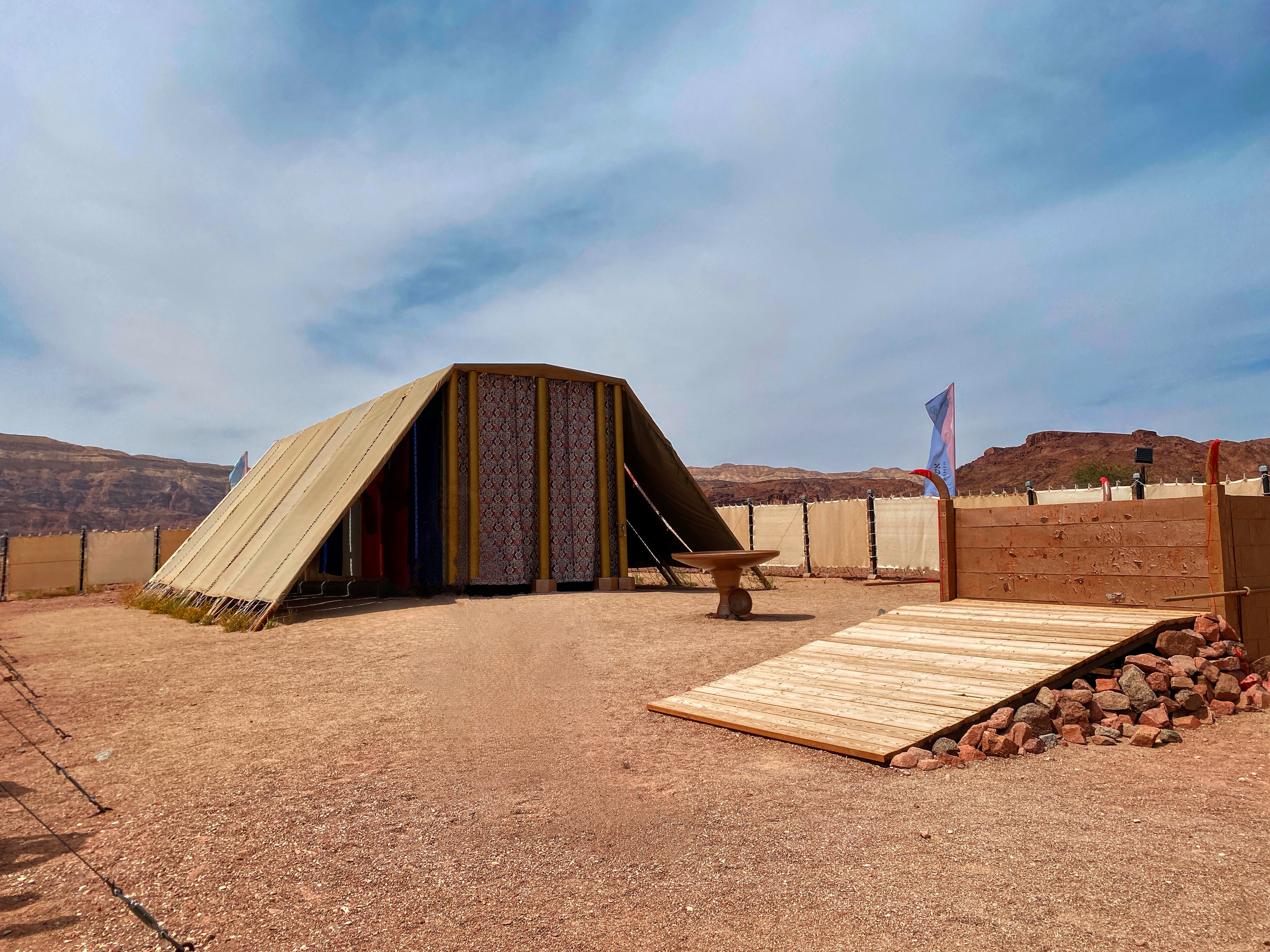
Once they were in the Promised Land and a kingdom was finally established, God gave the third king of Israel permission to build a more permanent worship site – the temple (see 1 Kings 6). However, because even the temple was built from corruptible materials in this sin-corrupted world, and because the people of the young nation were also sin-sick and twisted, the nation divided and eventually the first temple fell.

Yet even the temple is just a glimpse of our ultimate eternal worship place in the very presence of God. In the future city of the New Jerusalem, there will not even be a temple, “for its temple is the Lord God the Almighty and the Lamb” (Revelation 21:22). This will be our permanent home; this will be our permanent place of worship!

So what does this have to do with tents and suffering?

This body – this life – is all temporary. What’s more, it belongs to a reality in which everything has a contrasting opposite: up and down, good and evil, fast and slow, light and dark, and so forth. But when we are “born again,” as Peter mentions in 1 Peter 1:3 (see also John 3, et al), we die to this duality and are made into a new creation – one prepared to someday live in a reality without sin, darkness, death, and decay.

Yet until then, the new creatures we are still reside in these temporary, frail containers of meat and water. In this way, our physical bodies are like tents. And for those of us who are in Christ, our current bodies are temporary residences meant to be maintained long enough to function during our sojourn on earth, but they are not our permanent homes.

We are in essence camping in a foreign and often hostile territory on an ambassadorial mission for our King. We are sent here to represent Him to the world at large as well as to convince others the value of relinquishing their earthly citizenship and joining us in exile for the promise of a homecoming like no other.

Because we are not home, we will suffer the same homesickness, feelings of isolation, and sense of being misunderstood as any other stranger in a strange land. Also, because we are still housed in bodies inextricably tied to a planet broken by evil and sin, we will suffer just as all inhabitants of this world do. Sickness, death, and pain do not pass us by just because we are citizens of a different and eternal realm. We still live here, after all.

In addition to these general sufferings, there is the added complexity that we will suffer because of our choice to align ourselves with the King of kings, especially as we navigate in a world largely hostile to His message and dead-set (pun intended) on each individual being his or her own little god and calling the shots.

Suffering is part and parcel of the tent-dweller, and yet it is not all bad. Suffering strips us of self-reliance, of hubris, of many ignoble traits and daily reminds us we are not yet home. It also daily reminds us to rely on our God who is powerful and able to sustain us, even through suffering, until the day He calls us home.

Home.

It’s because of the promise of home we endure suffering. This homecoming will be unlike any earthly homecoming, because all of earth is still under the domination of sin. When our “tents” are destroyed and we clothe ourselves with our heavenly dwelling, all the bad things of the world will be destroyed along with them.

The new reality we were born into will finally be realized in its completeness. No more sorrow, no more shame, no more sin or death or pain or tears. All will be made new – even the heavens and the earth – and we will see the beauty of our King unveiled and in His splendor.

And THAT, my friends, is worth every ounce of suffering and more!

Then I saw a new heaven and a new earth, for the first heaven and the first earth had passed away, and the sea was no more. And I saw the holy city, new Jerusalem, coming down out of heaven from God, prepared as a bride adorned for her husband. And I heard a loud voice from the throne saying, “Behold, the dwelling place of God is with man. He will dwell with them, and they will be his people, and God himself will be with them as their God. He will wipe away every tear from their eyes, and death shall be no more, neither shall there be mourning, nor crying, nor pain anymore, for the former things have passed away.” And he who was seated on the throne said, “Behold, I am making all things new.” Also he said, “Write this down, for these words are trustworthy and true” (Revelation 21:1-5).

Talk about Transformation: Jacob

This one is for the sisters who are going through Warren W. Wiersbe’s devotional, Becoming New together.

Day 15 of Wiersbe’s book touches on the life of Jacob, but I would encourage each one of you to read the patriarch’s entire story from his birth recorded in Genesis 25 at least through the death of his father Isaac at the end of Genesis 35. You can read it all in less than half an hour, and in this season of focusing on transformation, there’s a lot to be learned about the power of our gracious God from the life of this hesitant father of our faith.

Living up to His Name

At birth, Jacob was holding his brother’s heel and so was named Jacob1, (Hebrew: יַעֲקֹב ; transliterated Ya’akov). It wasn’t a particularly flattering name to give to a baby. Most Bibles have a note stating the name means “supplanter,” which seems a little odd. However, a brief word study reveals why. The word picture here is of a person seizing another by the heel, literally tripping them up in order to restrain, deceive, outwit, or by other nefarious means take their place.

And indeed, the young man lived up to his name. He tripped up his elder brother Esau twice while they were young men. First, he took advantage of Esau’s exhaustion (and an apparently cavalier attitude toward the traditional birthrights given to the firstborn son) by withholding a bowl of stew until Esau promised to sell his birthright to his younger twin for food2.

But Jacob didn’t stop there. At his mother’s urging, he also stole his brother’s blessing from their father by listening to the voice of his mother (not the first time a man fell by obeying the voice of a woman – there’s a lesson in this for us, ladies). This time, Jacob lied to his father, posing as Esau and taking great measures to deceive the blind old man for the sake of taking Esau’s place of prominence in their father’s pronouncement of blessing3.

Skeptics R Us

As if his conniving and scheming to take his brother’s place wasn’t enough, the young Jacob also shows signs of being a skeptic. Rather than associating himself with the Almighty, for years he refers to God as “the Lord your God4” (when talking with his father) or “the God of my father.5

Sadly, his skepticism isn’t based on anything but hubris. Jacob continued to avoid associating Himself too closely with God even after the Lord sent him a dream proclaiming Himself to He Who Supplants, even reiterating the covenant He made with Abraham and Isaac to the rascally Jacob6.

And did our antihero man up and submit to the Almighty who was promising him such astonishing mercy despite his life of lies? No! Instead, he set up the rock he’d used as a pillow (ouch) and made a provisional promise to the Most High God. “If God will do thus and so for me, then I will deign to call Him my God.7

It’s all quite humorous until we look deeply at our own motives, isn’t it? When have we also laid conditions on our Creator, pledging our fidelity to Him in exchange for prosperity or something else we desire? As if we have anything to offer the One who holds all things together; as if He needed us at all! But I digress… back to Jacob.

Reaping What Was Sown

Jacob travels on and falls head-over-heels for the lovely Rachel, hiring himself out to her father Laban for seven years in exchange for her hand in marriage8. But the crafty Laban has other plans – in the dark of the wedding night, he veils his older and plainer daughter Leah and sends her into the marriage tent in place of her sister9. Because wine flowed freely at wedding banquets and the only light sources were the stars and fires, it isn’t until morning that Jacob realized he’d been deceived. Oh, what goes around comes around! And it keeps coming.

Jacob promises Laban another seven years of service in exchange for his beloved Rachel. Thus, his household is established on a sisterly rivalry that could not have been pleasant10.

Let me take an aside to point out a fact: many non-believers will use this example (and others) to say “biblical marriage” includes sister-wives and their maidservants; in short, polygamy. However, if one actually reads the words of the text, what we see is that God used the sin of Jacob for His greater plan while simultaneously meting out the consequences of Jacob’s sin. The rivalry and bitterness of Jacob’s wives did yield a household of peace and joy. God did not bless these choices, but He did redeem them. That’s what He does. Speaking of redemption, let’s go back to Jacob.

Even in this mess of being used and tricked by Laban, God speaks to Jacob and offers him guidance11 – even though we have yet to see Jacob call God anything other than the God of his ancestors or build a single altar to worship the Lord (I don’t think a single stone and a conditional pledge counts as worship). And Laban continues to trick Jacob by attempting to circumvent his request for the speckled and spotted flocks12.

But God’s plan cannot be circumvented. His purposes are bigger than Jacob and his bickering wives, bigger than the supplanter and his supplanter, and bigger even than all of their sin. God’s plan stretches through this debacle to establish the Nation of Isreal through whom the Messiah would one day come… but that is much later.

Becoming Broken

Jacob spent twenty years reaping the discord he sowed in his childhood home, and finally he was able to break free from Laban. On his journey to return to his homeland, the bald truth of what he did to Esau finally hits him. Fear of reprisal from the brother he tripped up and replaced seizes him, and the man finally shows a little humility.13

And Jacob said, “O God of my father Abraham and God of my father Isaac, O Lord who said to me, ‘Return to your country and to your kindred, that I may do you good,’ I am not worthy of the least of all the deeds of steadfast love and all the faithfulness that you have shown to your servant, for with only my staff I crossed this Jordan, and now I have become two camps. Please deliver me from the hand of my brother, from the hand of Esau, for I fear him, that he may come and attack me, the mothers with the children (Genesis 32:9-11).

For the first time, we see Jacob in a posture of understanding that the blessings he schemed for are not blessings he deserves. His heart his humbled, even if it is humbled out of mere self-preservation.

And that night, he wrestles with God. It isn’t until after the wrestling match, which resulted in a permanent physical disability, that Jacob finally builds a proper alter and worships the Living God14. It took time, consequences, suffering, and fear, but Jacob finally worships the God who graciously allows him to become a part of the lineage of His Messiah, through whom God would offer redemption to the whole world.

There’s much more to Jacob’s story than this overview. His wife Rachel stole her father’s household gods, and Jacob doesn’t rid his own household of this abomination until after the rape of his daughter Dinah and his sons’ over-the-top revenge.

My point? Jacob was not a perfect man by any stretch of the imagination. Yet he was a man transformed by God. What we see in Jacob is a solid reminder of the astonishing mercy and renewing power of our Living and Loving God. He uses our own bad choices to humble us, and yet there is no one out of reach of His redeeming grace.  

  1. Genesis 25:26 ↩︎
  2. Genesis 25:29-34 ↩︎
  3. Genesis 27 ↩︎
  4. Genesis 27:20 ↩︎
  5. Genesis 31:5, et al ↩︎
  6. Genesis 28:10-15 ↩︎
  7. Genesis 28:20-21 ↩︎
  8. Genesis 29:16-19 ↩︎
  9. Genesis 29:22-25 ↩︎
  10. Genesis 29-30 ↩︎
  11. Genesis 31:10-13 ↩︎
  12. Genesis 30:34-36 ↩︎
  13. Genesis 32:6-12 ↩︎
  14. Genesis 33:20 ↩︎

Blessing

O God, you are my God; earnestly I seek you; my soul thirsts for you; 
my flesh faints for you, as in a dry and weary land where there is no water. 
So I have looked upon you in the sanctuary, beholding your power and glory.
Because your steadfast love is better than life, my lips will praise you. So I will bless you as long as I live; in your name I will lift up my hands.
(Psalm 63:1-4)

So how are you holding up during COVID Madness? I’m still enjoying having all my family around for the most part. But I won’t lie: I miss my friends. I miss seeing one daughter play tennis, and this weekend, I’ll miss seeing my other daughter’s now-cancelled spring play.

Finances are a bit tight, too. I’d hoped for more chances to substitute at the school while working on this silly book and help out with our expenses -which have increased. And in truth, I’m a bit sick of never being able to keep the house clean.

Even still, I count myself very blessed.

Wild Violet

I am blessed not because life is perfect and my kids have all the opportunities we’ve sacrificed to give them. I’m blessed because I know the Creator of the universe. Because my Lord died to give me access to the Throne of Grace. Because in Christ, I have the astonishing privilege of meeting with the Almighty, of reading His word and talking to Him, every single day.

Each day, I also love to walk in my neighborhood and marvel at the beauty He’s placed all around me. Even the weeds here are pretty.

Even more, though, I marvel that the same God who put such detail in the tiniest of flowers has put the same amount of attention into the details of my life.

Every single thing – from chronic pain and fatigue to the challenges and joys of motherhood; from a childhood of sorrows to a roller-coaster adult life; from the roof over my head to the dirty floor under my feet – all of it, He has used for my good. Preparing me. Changing me. Growing me.

Because He is a good Father, my God has not kept me from hard things in life. Instead, He has used the hard things to teach me more about Himself. To expose my need of Him and to shred my awful pride.

I am blessed not because of what He gives me, but because of who He is. He is my God, my King, my Savior, and my Rock. He is my Reason for doing everything I do. And He is worth it, not because He is the Giver of good gifts. He is the Good Gift.

Whom have I in heaven but you? 
And there is nothing on earth that I desire besides you. 
My flesh and my heart may fail, 
but God is the strength of my heart and my portion forever.
(Psalm 73:25-26)

Y’all, I am totally in love with the Lord my God. Even now when life isn’t easy and the future is unknown. Truth be told, the future has always been unknown to me. But not to God.

Dwarf Larkspur along a trail

In Christ alone, I have peace. Apart from Him, I not only have nothing, I am nothing. But in His love, knowing that He is my future and my hope, I have Shalom. Peace.

Because His steadfast love is better than life, I will praise Him. No matter what.

Friends, I pray that You will seek Him with all your heart and find Shalom beneath the sheltering wings of the Most High. Even now. Especially now.

Rest

And he said to them, “The Sabbath was made for man, not man for the Sabbath. So the Son of Man is lord even of the Sabbath.”

Mark 2:27-28

Did you know the Sabbath is mentioned in 36 different verses in the first five books of the Bible (the Pentateuch) alone?

Besides those, 20 additional verses do not expressly use the term Sabbath but speak of a seventh day of rest, making an average of 11 mentions per book. In a written tradition using repetition for emphasis, this commandment is underscored with greater intensity than the one prohibiting murder.

Let that sink in a moment.

On this year’s trip through the Bible, I’ve been drawn to the numerable mentions of Sabbath and have been prayerfully meditating on why. By God’s grace, I think I’m beginning to see glimpses of a few reasons.

There’s too much for a blog post, really, but I wanted to look at one facet: Have you ever wondered why God would command us to rest when rest is not only something we all need, but also a wonderful gift?

I think in part, this is so we would see the rebelliousness of our own stubborn hearts.

Sabbath – one day in every 7 to rest – is really an enormous benefit to our mental, physical, and spiritual health. But of course, we humans have an incorrigible contrariness about us when it comes to God and His commands. We tend to want to do things our way, decide we know what’s best – even decide for ourselves what is right and wrong.

And we’ve decided Sabbath isn’t all that important. Especially today in our 24/7, fast-paced world, rest is something we would much rather complain we can’t find. A glance at the mental health statistics in my country suggests how well this is working for us.

Maybe that’s what is going on now with COVID-19. Maybe, just maybe, this is a kind of Sabbath thrust upon a people who refused it otherwise.

In America, we often talk about how busy we are, how we never have time to stop. Some of us even claim we find it a struggle to read our Bibles every day.

Well now we have time. What are we going to do with it?

Isaiah advises:

“If you turn back your foot from the Sabbath, from doing your pleasure on my holy day, and call the Sabbath a delight and the holy day of the LORD honorable; if you honor it, not going your own ways, or seeking your own pleasure, or talking idly; then you shall take delight in the LORD, and I will make you ride on the heights of the earth; I will feed you with the heritage of Jacob your father, for the mouth of the LORD has spoken.”

Isaiah 58:13-14

What if we rested? Physically, yes, but also embracing the full idea of Sabbath as God meant it to be. Keeping it holy. Dedicating it to Him. Taking delight in Him, in His Word, in worship of Him.

What if we took this time – these next few days or weeks or whatever it turns out to be – and really dove in deep to Bible study, to prayer, to searching our hearts, and repenting of sin?

What if we really pondered the Word of God and spent time talking through it with its Author?

What if we pressed into obedience and taking every thought captive to obey Christ and honestly loving God with all our hearts and souls and minds?

What if we did this openly with our families, praying together, reading together, talking about the greatness of God together?

What kind of peace and joy might that bring?

This time of quarantine and social distancing could be lonely, frightening, and difficult. Or it could be the greatest blessing we’ve ever received.

So? What are you going to do with it?

Taking It Personally

He who has an ear, let him hear what the Spirit says to the churches.

Revelation 2:29

I’ve often heard it said that the church from Revelation which most resembles the modern American church is the lukewarm, spoiled church of Laodicea. And this is true.

As a whole, we do tend to be complacent in a rather shallow, wealthy, and self-serving social club we call the church. We neither offer a refreshing drink of cool Living Water to the world around us nor a sanitizing scalding from the heat of holy fire. We are, to use the modern vernacular, meh.

But the letter to Laodicea isn’t the only one we could take to heart as a solemn warning. Like Ephesus, many of us have forgotten our first love of the Lord – going through acts of service as if our works will save us and not His grace. We can be guilty of making service into an idol, serving others out of humanistic motives rather than from an overflow of the love of God in our hearts.

Like Pergamum, we think we can compromise with the world. We think we can trust the modern-day Balaams who go thrice with the kings who desire to curse God’s people and eventually urge us to mingle our God-ordained values with the fluctuating and unstable mores of the world around us.

Behold, these, on Balaam’s advice, caused the people of Israel to act treacherously against the LORD in the incident of Peor…

Numbers 31:16a

Like Thyatira, we tolerate sexual sin within our churches and the exploitation of our freedom in Christ to the point of causing others to stumble when they see us behaving in a way which appears to them to compromise with the culture’s petty gods.

In those days, some would see the eating of food sacrificed to idols as actual worship of said idols. Today, the practices are more subtle but not less damaging to the consciences of others and are still tolerated within the Body of Christ. For us just as for them, tolerance has become a pitiful alternative to love.

Thus, sinning against your brothers and wounding their conscience when it is weak, you sin against Christ.

1 Corinthians 8:12

Like Sardis, we are capable of pantomiming vigorous, Spirit-led worship, while inside we are spiritually dead. What looks like worship is sometimes nothing more than reactivity to stirring music; automatons who respond to stimulus, going through the rote of worship while failing to truly adore and serve the Lord our God.

But I want to take these things more personally. Not us, not we, but me.

Where do I stand in all this? Is my worship genuine and alive or just a task I check off my list? What evils am I overlooking in my heart or my home, tolerating them in the name of getting along and not rocking the proverbial boat? Where am I compromising with culture or serving others just because I should but without the love of Christ? Have I grown stale and complacent in my walk with the Lord?

For me, this season is a time of prayerful self-examination. I invite the Lord to answer these questions, exposing sin in me so that I may repent and turn fully to Him. You see, I believe the promises He gives to the one who conquers. I long for them.

I want to eat of the tree of life, enjoy the hidden manna of His presence, receive my new name, be given the Morning Star, and be clothed in bridal white before my King. I long to be with Him forever, enjoying Him and His people and utterly free from the battle against sin and death that I constantly wage in my earthly body.

And in my longing, there is a strong desire never, ever to grow spiritually lazy and complacent.

Oh Lord, grant that I may always grow in Your love and wisdom and in the knowledge of You. Bring revival to my heart, my home, and Your Church and restore us to our first love. Teach us to repent of tolerance and compromise, of lifeless worship and service by rote. Teach us to hunger for Your Word and desire Your Kingdom above all. Remove the god of entertainment from the throne of Your Church and restore us to proper zeal and reverence for You. May it be to us for Your glory and Your Name’s sake, amen.

Sanctuary

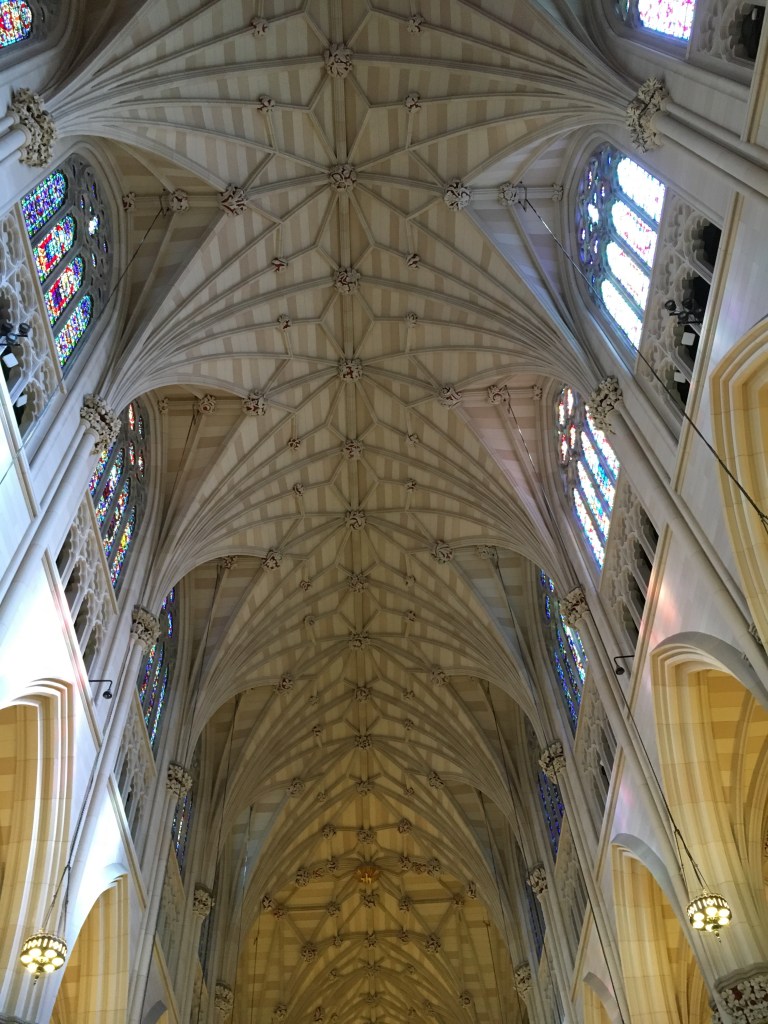
Last week, I chaperoned my tenth-grader’s field trip to New York City. One memorable site we visited, at least to me, was the magnificent St. Patrick’s Cathedral.

As is often the case with field trips, we had little time in the building. Still, for the time I had, I trailed my fingers over the heavy polished wooden pews as I took in the ornate ceiling, columns, and alcoves all bathed in light filtered through stained glass windows.

My thoughts strayed from the sights before my eyes to the beautiful descriptions of the two Temples given in Scripture. For a moment, my heart stirred with sorrow and I whispered, “O Lord, when did we stop building You such glorious houses of worship?”

He whispered back, “This is not My house, child. You are.”

Do you not know that you are God’s temple and that God’s Spirit dwells in you?

1 Corinthians 3:16

The thought has been with me since.

On this day, Ash Wednesday, the first day of Lent, I invite you to join with me in an endeavor which will have eternal benefits. Now that God’s people are His house – His temple – let’s do a little spiritual housecleaning. If our bodies are God’s temple, ought we not be certain the bodies we offer Him are worthy of His residence?

So by His grace and with the sound counsel of the Paraclete – the Holy Spirit our Helper – let’s resolve to search our temples by the Light of the Word. When we find something unsavory or rotten, let’s remove it, banishing it from the house. What is filthy, let’s cleanse; what is ugly, let’s beautify; what is dishonorable, let’s cast out.

From here on out, let’s join together in Christ to become a Temple of incredible beauty. Let the worship performed in these, our temples, be genuine, breaking forth from the overflow of gratitude for His sacrifice which has set us free from sin.

Then let us choose to live as free men and women every single day. Let’s keep these houses swept clean of debris and deceit. Daily, we’ll let the Light in so that by the light of the Word we can see clearly. We’ll let the Spirit of God do His work in us, putting our houses in order so that by our lives and in our bodies, we can magnify the beauty of our great and awesome God!

Or do you not know that your body is a temple of the Holy Spirit within you, whom you have from God? You are not your own, for you were bought with a price. So glorify God in your body.

1 Corinthians 6:19-20

Fountain

Thanks to the flu (which I have so far evaded) hitting my home, I’ve little time to engage on social media this week. So here’s an oldie from 2014 that I needed to re-read today! ❤

Be appalled, O heavens, at this; be shocked, be utterly desolate, declares the LORD, for my people have committed two evils: they have forsaken me, the fountain of living waters, and hewed out cisterns for themselves, broken cisterns that can hold no water.

Jeremiah 2:12-13

We do not like to hear difficult news. It isn’t much fun, I have to admit, especially when said news involves an uncomfortably close look at my own behavior. My pride doesn’t enjoy the buffeting that comes from a confrontation of my sin.

However, the longer I have walked with God, the more I see the absolute necessity of these moments. If I cannot humbly ask God to search my heart and know my thoughts, well… I am not drinking deep from the Fount of living water but trusting in the cracked and leaky vessel of my silly and rather vain human pride, either by trusting in my own effort or ability or by accepting a cultural standard that is man-made and fleeting. This brief passage in Jeremiah has given me pause for both personal reflection and for a close look at my expectations as a part of the Church at large.

Lately I have been wondering how much of our modern church services are driven by such cultural expectations and efforts. Have we allowed the show to upstage the Almighty?

I love some stirring music as much as the next gal, but I do sometimes fear that what passes for “worship” in many churches today is not actually the unadorned worship of the Father. I fear it isn’t fueled by a hunger for His Word and His presence and marked by repentance and obedience, but by something far inferior. I fear that it is nothing more and nothing less than emotional response.

The plain fact is, we do not need music or color-coordination or conducive environments to worship. Worship just happens, and it happens from a recognition of the majesty and worthiness of God. Worship cannot be manufactured: it is the natural response to our mighty King.

Just the other day as I read Jeremiah 2 to my kids, I pondered it in light of the current church trends. When we, the Church, allow human expectations to define our worship services, are we then trusting in the Fountain of Living Water? Or have we hewn out cisterns for ourselves, cisterns that we expend enormous energy trying vainly to fill only to watch our efforts drain away while we sit by, exhausted and helpless to stop the leak?

I do not claim to know the answers; it is just something I have been contemplating. I do know, however, that many people are out there searching, searching for just the right worship environment rather than simply seeking the limitless Fountain which will, without fail, well up to an overflow.

I have experienced that worship can happen in the midst of intense pain as well as in the midst of beautiful and stirring music. True worship is really a reflexive response to the work of the Holy Spirit and cannot be conjured by any amount of human effort or will. I hope to see a return to sincere worship in our churches in my lifetime. I pray to see it in my own heart, as well.

God has made me realize lately just how deeply I, too, have based my ideologies and standards upon these fractured and fragile, man-hewn cisterns. You see, I tend to view my life–my use of time and other resources, how busy I am, my assessment of my own spiritual condition–not by God’s standards but by measuring them against my peers.

This is an area in which God has been dealing with me lately, pointing to the leaks and flaws in the cisterns I am pouring my energy into and beckoning me to sit by His Fountain and be filled.

I spent years striving ceaselessly to keep my spiritual life “full,” but for years I neglected to begin with humility, repentance and surrender. I have tried to be “good,” but in the end my best efforts are no better than filthy rags. What I need is to abide–to be a part of the living Vine, to trust entirely in the Fountain of Living Water and allow His life, power, and love to suffuse every element of my being until I am utterly eclipsed by it. May He increase and I decrease.

My prayer today, Father, is that I will no longer commit these two evils. Teach me to forsake my flawed human understanding and surrender entirely to Your perfect will. May Your Living Water well up within me to an overflow, for the glory of Your Kingdom and of Your name.

Let it be Your power that others see in me–power over sin and over the cares of this world. I ask for Your forgiveness for my arrogance in carving out my own, leaky vessels. I pray, too, for Your forgiveness for our churches. I pray that we, as Your Bride, would humble ourselves completely and listen to Your will for us. Help us to let go of all expectations that we have created and heaped upon ourselves and open our hearts to pure and sincere worship of You, our King.

Thus says the LORD: “Stand by the roads, and look, and ask for the ancient paths, where the good way is; and walk in it, and find rest for your souls…

Jeremiah 6:16

Looking for the King

Now there was a man in Jerusalem, whose name was Simeon, and this man was righteous and devout, waiting for the consolation of Israel, and the Holy Spirit was upon him. And it had been revealed to him by the Holy Spirit that he would not see death before he had seen the Lord’s Christ.

Luke 2:25-26

During Christmastime, it’s not unusual to hear from all corners references to that ancient pair of travelers, Mary and Joseph, and their trek to Bethlehem. Songs about the birth of Jesus or the heavenly chorus which was performed for shepherd are occasionally played even on secular stations, and I’ve heard tell that some broadcasters will air A Charlie Brown Christmas complete with Linus’s recital of 2:8-14.

The story isn’t new to Christians. It isn’t even new to some who do not know the Lord. But how many continue reading in Luke past the point of the shepherds and their rejoicing? There’s more to the coming of the King than His undignified birth amidst the stench of a stable.

Forty days after His birth, the young couple would make a journey to Jerusalem because Mary’s time of purification according to Levitical law was at hand.  On this exciting day, we are told, they brought a sacrifice “according to what is said in the Law of the Lord: ‘A pair of turtledoves or two young pigeons.'”  (Luke 2:24)

A quick glance back to Leviticus 12:6-8 will reveal that the sacrifice of a pair of birds was a provision for those who could not afford to offer both a lamb and a bird for the ritual purification after childbirth. 

And if she cannot afford a lamb, then she shall take two turtledoves or two pigeons, one for a burnt offering and the other for a sin offering. And the priest shall make atonement for her, and she shall be clean.”

Leviticus 12:8, see also 12:2-4, 6-7

The idea of Jesus’s humble beginnings is not new, of course, but it bears fresh meditation as we approach the day of celebration. Most of us are familiar with the fact that His first bed was not one of down and silk in a palace, but scratchy straw in a place meant to feed animals. But it strikes me even deeper that Mary and Joseph brought two birds for the sacrifice, unable to even afford a lamb for the ritual purification of the mother of the Lamb of God.  

Now there was a man in Jerusalem, whose name was Simeon, and this man was righteous and devout, waiting for the consolation of Israel, and the Holy Spirit was upon him. And it had been revealed to him by the Holy Spirit that he would not see death before he had seen the Lord’s Christ. And he came in the Spirit into the temple, and when the parents brought in the child Jesus, to do for him according to the custom of the Law, he took him up in his arms and blessed God…

Luke 2:25-28

Despite the lowly circumstances of His earthly parents and the complete lack of any of the trappings of royalty, two people at the temple that day recognized Him. A man named Simeon who’d received a promise that he wouldn’t die before he saw the Messiah, and an old widow named Anna.

A few years ago as I re-read this story, one fact really captured my attention as I read: Anna was at the temple that day, as she was every day, worshiping God.

… [Anna] did not depart from the temple, worshiping with fasting and prayer night and day. And coming up at that very hour she began to give thanks to God and to speak of Him to all who were waiting for the redemption of Jerusalem.

Luke 2:37-38

 Somehow I doubt that Simeon and Anna were the only folks in the temple that day, yet they are the only ones mentioned who recognized the Messiah.

In our modern ways of worship, I sometimes fear we have allowed musical selections or environments or programs or gear or technology or a myriad other useful and even wonderful tools to drown out the simple, unassuming message of our King.

Perhaps this is more apparent at Christmastime. During the season when we are purportedly celebrating His birth, don’t we often find ourselves more caught up in the details of hymn selections and service times, or of parties and decor instead of being caught up with love and adoration of the One we are supposed to be celebrating? I confess that I sometimes do.

Don’t get me wrong – I love worship services both classic and modern and hymns both old and new. I also enjoy the entire Christmas season. But every year, I have to ask myself if I am still seeking the King in the midst of the festivities and activities. 

Anna worshiped. Simeon waited. Both recognized their King and rejoiced. What am I doing today?

I sincerely hope that I will not be found sitting in a place of worship going through the motions of devotion and somehow overlooking Him in the midst of it all! I hope that I, like Simeon and Anna, will recognize the Messiah in my days no matter how quietly and unassumingly He presents Himself.

Gracious God, forgive me for so often being concerned with the “hows” of worshiping You and neglecting actual worship. During this Advent season and forever after, help me to be alert to Your presence, looking attentively for you, eagerly anticipating Your appearance in my days as both Simeon and Anna did. May I never miss You whether You come heralded by trumpets or as subtly as a gentle whisper, amen.

Tuesday Prayer: Worship

Therefore, since we are surrounded by so great a cloud of witnesses, let us also lay aside every weight, and sin which clings so closely, and let us run with endurance the race that is set before us, looking to Jesus, the founder and perfecter of our faith, who for the joy that was set before him endured the cross, despising the shame, and is seated at the right hand of the throne of God. 
(Hebrews 12:1-2)

Lord, as we celebrate this Christmas season, let us not forget You as the Founder and Perfecter of our faith. You are the One true God, holy and pure, and in Your unfathomable mercy, You have established the ability to worship within the human heart. In fact, You created us to worship with the intent that You would be the recipient of our cravings and our praise.

Today we confess that we too often allow other things to eclipse Your glory in our lives. The Christmas season can be especially so, for although we sometimes say things like, ” Jesus is the reason for the season,” our actions sometimes betray where our true devotions lie. We can get so caught up in the busy-ness and the secular pressures of buying and giving that we forget Whose birthday it is we celebrate.

But the Lord answered her, “Martha, Martha, you are anxious and troubled about many things, but one thing is necessary. Mary has chosen the good portion, which will not be taken away from her.”
(Luke 10:41-42)

So it is that we look to You as the Author and Perfecter of our faith. Lord, take our small faith and make it grow. Hone it, refine it, purify it, and make it into something which reflects Your glory to others. Take away all that eclipses Your majesty in our lives, turning our eyes from worthless things and giving us life in Your ways. Make us to love Your Scriptures more, reminding us that it is the very Word of Life to us.

 Give us a passion for Your Kingdom, a hunger for Your presence, and a never-ending thirst for the Living Water. Forgive our lack of trust and help us to trust You more. Fix our eyes on You and ascend the throne of our hearts as our rightful King. May it be that our worship of You is evident to all, shining like a light in the darkness of this world and acting as a guide to bring others to walk and live in the light of Your love, amen.

Tuesday Prayer: Idols

Thus says the LORD, the King of Israel and his Redeemer, the LORD of hosts: “I am the first and I am the last; besides me there is no god.
(Isaiah 44:6)

Most High, as You spoke through the prophet centuries ago, You are the first and the last and apart from You there is no God. You are the sole and supreme Authority, the One who existed before all else and in whom all things are held together. Everything is part of Your creation, made to serve Your purposes and subject to Your plans. Teach us to magnify Your name as it should be done and to serve no other God.

Lord, as we spend more time in Your word, the more we are forced to confront those areas in our lives which fall short of bringing You honor and glory. As we examine our hearts, our lives, and our loyalties through the light of Your truth, we find we are not so far removed from the faithless children of Israel as we would like to think. Like them, when You appear before us in glory we fall to our faces in awe, but also like them, when an obstacle appears or when Your promises seem delayed, we quickly fall prey to fear or turn our hearts to yearn after some other thing.

And the LORD said to Moses, “Go down, for your people, whom you brought up out of the land of Egypt, have corrupted themselves. They have turned aside quickly out of the way that I commanded them. They have made for themselves a golden calf and have worshiped it…
(Exodus 32:7-8a)

Forgive us for our idolatry, subtle though it may be! Whether what we serve is our careers, our families, our pleasures, entertainments, or any other created thing, we pray that You will reveal all of them no matter how painful. And Lord, we invite You to tear down the idols, asking only that You will give us the faith and trust to work with You in removing whatever we have erected in the place of worship within our hearts.

As we submit to this process, we look forward to the freedom we will experience by walking fully and humbly in Your will. We long to see You exalted in our lives and ask for You to fill our hearts more and more with love for You.

Let us be genuine Kingdom seekers first and foremost, not serving you out of one side of our mouths and serving ourselves out of the other. Instead, Lord, make us fully Yours; a people of undivided minds and hearts loving You and serving You wholeheartedly. As we walk out our trust, use the light of Your freedom shining through our lives to set others free. May Your word speed ahead and be honored in us, in our families, and in every place we go with You, amen.