Why Do We Still Suffer?

Wednesday night at my church, our pastor asked an interesting question regarding 1 Peter 1:5. The passage reads, “…who, by God’s power, are being guarded through faith for a salvation ready to be revealed in the last time.” Pastor John asked us how we would respond to someone asking why Christians still suffer if our God is guarding us through faith.

In other words, if God is so powerful and loving and if He truly guards His own, why do His people still deal with sickness, loss, grief, financial ruin, and the like?

My first thought was of Paul’s words in 2 Corinthians 5:1-2: “For we know that if the tent that is our earthly home is destroyed, we have a building from God, a house not made with hands, eternal in the heavens. For in this tent we groan, longing to put on our heavenly dwelling…”

I think of it as the tabernacle/temple/eternity paradigm.

Incredibly, God gave us an illustration of worship in temporary accommodations while in exile when He gave the budding nation of Israel the tabernacle (a specific type of tent) in which to worship Him during their journey between Egypt, the place of their captivity, and the Promised Land. You can read about it in the book of Exodus.

Once they were in the Promised Land and a kingdom was finally established, God gave the third king of Israel permission to build a more permanent worship site – the temple (see 1 Kings 6). However, because even the temple was built from corruptible materials in this sin-corrupted world, and because the people of the young nation were also sin-sick and twisted, the nation divided and eventually the first temple fell.

Yet even the temple is just a glimpse of our ultimate eternal worship place in the very presence of God. In the future city of the New Jerusalem, there will not even be a temple, “for its temple is the Lord God the Almighty and the Lamb” (Revelation 21:22). This will be our permanent home; this will be our permanent place of worship!

So what does this have to do with tents and suffering?

This body – this life – is all temporary. What’s more, it belongs to a reality in which everything has a contrasting opposite: up and down, good and evil, fast and slow, light and dark, and so forth. But when we are “born again,” as Peter mentions in 1 Peter 1:3 (see also John 3, et al), we die to this duality and are made into a new creation – one prepared to someday live in a reality without sin, darkness, death, and decay.

Yet until then, the new creatures we are still reside in these temporary, frail containers of meat and water. In this way, our physical bodies are like tents. And for those of us who are in Christ, our current bodies are temporary residences meant to be maintained long enough to function during our sojourn on earth, but they are not our permanent homes.

We are in essence camping in a foreign and often hostile territory on an ambassadorial mission for our King. We are sent here to represent Him to the world at large as well as to convince others the value of relinquishing their earthly citizenship and joining us in exile for the promise of a homecoming like no other.

Because we are not home, we will suffer the same homesickness, feelings of isolation, and sense of being misunderstood as any other stranger in a strange land. Also, because we are still housed in bodies inextricably tied to a planet broken by evil and sin, we will suffer just as all inhabitants of this world do. Sickness, death, and pain do not pass us by just because we are citizens of a different and eternal realm. We still live here, after all.

In addition to these general sufferings, there is the added complexity that we will suffer because of our choice to align ourselves with the King of kings, especially as we navigate in a world largely hostile to His message and dead-set (pun intended) on each individual being his or her own little god and calling the shots.

Suffering is part and parcel of the tent-dweller, and yet it is not all bad. Suffering strips us of self-reliance, of hubris, of many ignoble traits and daily reminds us we are not yet home. It also daily reminds us to rely on our God who is powerful and able to sustain us, even through suffering, until the day He calls us home.

Home.

It’s because of the promise of home we endure suffering. This homecoming will be unlike any earthly homecoming, because all of earth is still under the domination of sin. When our “tents” are destroyed and we clothe ourselves with our heavenly dwelling, all the bad things of the world will be destroyed along with them.

The new reality we were born into will finally be realized in its completeness. No more sorrow, no more shame, no more sin or death or pain or tears. All will be made new – even the heavens and the earth – and we will see the beauty of our King unveiled and in His splendor.

And THAT, my friends, is worth every ounce of suffering and more!

Then I saw a new heaven and a new earth, for the first heaven and the first earth had passed away, and the sea was no more. And I saw the holy city, new Jerusalem, coming down out of heaven from God, prepared as a bride adorned for her husband. And I heard a loud voice from the throne saying, “Behold, the dwelling place of God is with man. He will dwell with them, and they will be his people, and God himself will be with them as their God. He will wipe away every tear from their eyes, and death shall be no more, neither shall there be mourning, nor crying, nor pain anymore, for the former things have passed away.” And he who was seated on the throne said, “Behold, I am making all things new.” Also he said, “Write this down, for these words are trustworthy and true” (Revelation 21:1-5).

Sanctuary

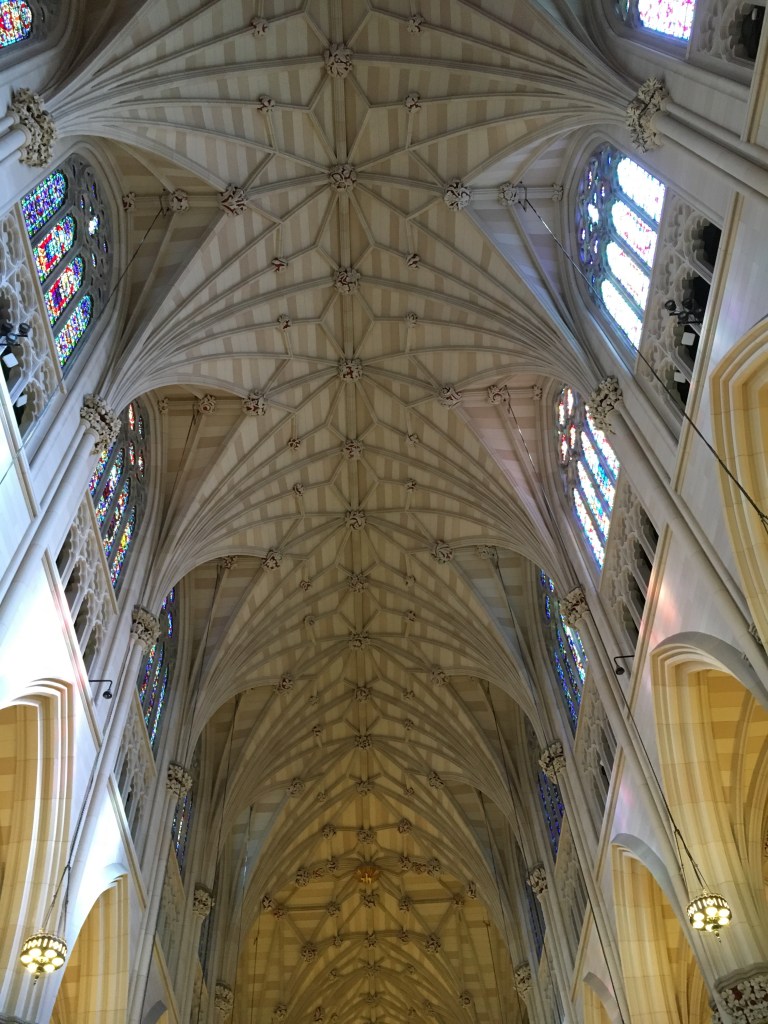
Last week, I chaperoned my tenth-grader’s field trip to New York City. One memorable site we visited, at least to me, was the magnificent St. Patrick’s Cathedral.

As is often the case with field trips, we had little time in the building. Still, for the time I had, I trailed my fingers over the heavy polished wooden pews as I took in the ornate ceiling, columns, and alcoves all bathed in light filtered through stained glass windows.

My thoughts strayed from the sights before my eyes to the beautiful descriptions of the two Temples given in Scripture. For a moment, my heart stirred with sorrow and I whispered, “O Lord, when did we stop building You such glorious houses of worship?”

He whispered back, “This is not My house, child. You are.”

Do you not know that you are God’s temple and that God’s Spirit dwells in you?

1 Corinthians 3:16

The thought has been with me since.

On this day, Ash Wednesday, the first day of Lent, I invite you to join with me in an endeavor which will have eternal benefits. Now that God’s people are His house – His temple – let’s do a little spiritual housecleaning. If our bodies are God’s temple, ought we not be certain the bodies we offer Him are worthy of His residence?

So by His grace and with the sound counsel of the Paraclete – the Holy Spirit our Helper – let’s resolve to search our temples by the Light of the Word. When we find something unsavory or rotten, let’s remove it, banishing it from the house. What is filthy, let’s cleanse; what is ugly, let’s beautify; what is dishonorable, let’s cast out.

From here on out, let’s join together in Christ to become a Temple of incredible beauty. Let the worship performed in these, our temples, be genuine, breaking forth from the overflow of gratitude for His sacrifice which has set us free from sin.

Then let us choose to live as free men and women every single day. Let’s keep these houses swept clean of debris and deceit. Daily, we’ll let the Light in so that by the light of the Word we can see clearly. We’ll let the Spirit of God do His work in us, putting our houses in order so that by our lives and in our bodies, we can magnify the beauty of our great and awesome God!

Or do you not know that your body is a temple of the Holy Spirit within you, whom you have from God? You are not your own, for you were bought with a price. So glorify God in your body.

1 Corinthians 6:19-20

Looking for the King

Now there was a man in Jerusalem, whose name was Simeon, and this man was righteous and devout, waiting for the consolation of Israel, and the Holy Spirit was upon him. And it had been revealed to him by the Holy Spirit that he would not see death before he had seen the Lord’s Christ.

Luke 2:25-26

During Christmastime, it’s not unusual to hear from all corners references to that ancient pair of travelers, Mary and Joseph, and their trek to Bethlehem. Songs about the birth of Jesus or the heavenly chorus which was performed for shepherd are occasionally played even on secular stations, and I’ve heard tell that some broadcasters will air A Charlie Brown Christmas complete with Linus’s recital of 2:8-14.

The story isn’t new to Christians. It isn’t even new to some who do not know the Lord. But how many continue reading in Luke past the point of the shepherds and their rejoicing? There’s more to the coming of the King than His undignified birth amidst the stench of a stable.

Forty days after His birth, the young couple would make a journey to Jerusalem because Mary’s time of purification according to Levitical law was at hand.  On this exciting day, we are told, they brought a sacrifice “according to what is said in the Law of the Lord: ‘A pair of turtledoves or two young pigeons.'”  (Luke 2:24)

A quick glance back to Leviticus 12:6-8 will reveal that the sacrifice of a pair of birds was a provision for those who could not afford to offer both a lamb and a bird for the ritual purification after childbirth. 

And if she cannot afford a lamb, then she shall take two turtledoves or two pigeons, one for a burnt offering and the other for a sin offering. And the priest shall make atonement for her, and she shall be clean.”

Leviticus 12:8, see also 12:2-4, 6-7

The idea of Jesus’s humble beginnings is not new, of course, but it bears fresh meditation as we approach the day of celebration. Most of us are familiar with the fact that His first bed was not one of down and silk in a palace, but scratchy straw in a place meant to feed animals. But it strikes me even deeper that Mary and Joseph brought two birds for the sacrifice, unable to even afford a lamb for the ritual purification of the mother of the Lamb of God.  

Now there was a man in Jerusalem, whose name was Simeon, and this man was righteous and devout, waiting for the consolation of Israel, and the Holy Spirit was upon him. And it had been revealed to him by the Holy Spirit that he would not see death before he had seen the Lord’s Christ. And he came in the Spirit into the temple, and when the parents brought in the child Jesus, to do for him according to the custom of the Law, he took him up in his arms and blessed God…

Luke 2:25-28

Despite the lowly circumstances of His earthly parents and the complete lack of any of the trappings of royalty, two people at the temple that day recognized Him. A man named Simeon who’d received a promise that he wouldn’t die before he saw the Messiah, and an old widow named Anna.

A few years ago as I re-read this story, one fact really captured my attention as I read: Anna was at the temple that day, as she was every day, worshiping God.

… [Anna] did not depart from the temple, worshiping with fasting and prayer night and day. And coming up at that very hour she began to give thanks to God and to speak of Him to all who were waiting for the redemption of Jerusalem.

Luke 2:37-38

 Somehow I doubt that Simeon and Anna were the only folks in the temple that day, yet they are the only ones mentioned who recognized the Messiah.

In our modern ways of worship, I sometimes fear we have allowed musical selections or environments or programs or gear or technology or a myriad other useful and even wonderful tools to drown out the simple, unassuming message of our King.

Perhaps this is more apparent at Christmastime. During the season when we are purportedly celebrating His birth, don’t we often find ourselves more caught up in the details of hymn selections and service times, or of parties and decor instead of being caught up with love and adoration of the One we are supposed to be celebrating? I confess that I sometimes do.

Don’t get me wrong – I love worship services both classic and modern and hymns both old and new. I also enjoy the entire Christmas season. But every year, I have to ask myself if I am still seeking the King in the midst of the festivities and activities. 

Anna worshiped. Simeon waited. Both recognized their King and rejoiced. What am I doing today?

I sincerely hope that I will not be found sitting in a place of worship going through the motions of devotion and somehow overlooking Him in the midst of it all! I hope that I, like Simeon and Anna, will recognize the Messiah in my days no matter how quietly and unassumingly He presents Himself.

Gracious God, forgive me for so often being concerned with the “hows” of worshiping You and neglecting actual worship. During this Advent season and forever after, help me to be alert to Your presence, looking attentively for you, eagerly anticipating Your appearance in my days as both Simeon and Anna did. May I never miss You whether You come heralded by trumpets or as subtly as a gentle whisper, amen.