Less Popular Perspectives on God’s Call

Then the LORD said to Abram, “Know for certain that your offspring will be sojourners in a land that is not theirs and will be servants there, and they will be afflicted for four hundred years. But I will bring judgment on the nation that they serve, and afterward they shall come out with great possessions. As for you, you shall go to your fathers in peace; you shall be buried in a good old age. And they shall come back here in the fourth generation…” (Genesis 15:13-16, ESV).

Besides the usual seasonal blahs I associate with Tennessee’s grey January weather, I’m coping with a (thus far, blessedly mild) return of a few ME symptoms, a rather barren season of life, and a dose of reality that led to the digital sulks permeating my last post. I feel it critical to state that my own lament, like most of the laments in the Psalms, does not reflect a turning away from God and His goodness, but a pressing into Him even in moments where I can’t see, feel, touch, taste, or otherwise sense His goodness. In my continued Scripture reading and prayer, He reminds me of the less popular truths behind His call.

Bleak seasons are a reminder that God is good because goodness is His nature, not because of what He does or does not do. His goodness has nothing to do with my subjective feelings about either Him or my circumstances.

As I’ve pondered my own understanding of God’s call to write about what He teaches me and His work in my life, it occurred to me how much of my own expectations I added to the call. My sense of failure isn’t God’s fault – it’s mine. He never promised anything; He just gave me a directive.

I embellished it. I see my Western background showing up clearly here.

You see, historical Middle Eastern peoples did not necessarily think of “God’s promises and call to me,” so much as “God’s promise and call to my house (my clan, my family, my people).” It’s a nuance most of us overlook in the hyper-individualistic West, but one worth examining.

When God calls us to do something, He doesn’t necessarily mean we will soon enjoy the fruits of our labors. Indeed, often our lives on earth may end before our cultivated areas bud, much less produces ripened fruit. His plan is much more far-reaching than our feeble little lives; a fact we easily overlook or forget.

We can see this in Abraham’s life. God promised Abraham many things – an heir, the land of Canaan, that all nations of the world would be blessed through him. Still, Abraham waited around 25 years1 between the promise of an heir and the birth of Isaac, the son of the covenant. The only land he owned in Canaan was the cave and field2 of Machpelah where he and Sarah were buried, and the Blessing for all the nations of the world would not come for another 2,000 years or so3.

Then there’s Moses, the lawgiver and the shepherd of Israel through the decades of wilderness wandering. Although his calling was incredible, like many of us, his obedience was less than perfect. His was the privilege of leading God’s people out of Egypt, yet while he was allowed to see the Promised Land from a mountain, he did not set a mortal foot inside its borders4.

There are many other examples – these are just the two that come most readily to mind. It’s not a popular view, but it is important to remember that God’s promises and call do not come with a guarantee of worldly success. They DO come with a promise of His presence, His glory, His purpose, and His goodness.

Sometimes I lose sight of the truth that He is my shield and my great reward. God Himself is the reward, not the fruit of my labors nor the gifts He gives. Just Him. Which is more than I deserve.

Even so, He blesses me in small ways to remind me that His love, while broader in scope than my tiny imagination can cope with, is also quite personal. Today, my King blessed my bird nerdiness with a beautiful surprise right in the middle of my communion with Him.

And I am reminded His ways are not my ways; His thoughts are not my thoughts. I am humbled, content, and grateful to play even a small, invisible part in the work of a Kingdom crossing all barriers of geography, ethnicity, and even time.

When I think of it in those terms, how silly it seems to imagine my part as anything more than a trifling contribution to a magnum opus far beyond any mortal scope.

  1. See Genesis 15:2-4; 16:15-17:1; 18:10; 21:1-5 ↩︎
  2. See Genesis 23:17-20; 25:9-10 ↩︎
  3. Matthew 1 ↩︎
  4. Exodus 34 ↩︎

Half a Century | A Reflection

On March 10, 1974, a tiny human protested the forceful eviction from the warmth of her first home into a cold shock of light and noise.

That is to say, this past March, I turned 50. Oddly enough, checking the box labeled 50-59 doesn’t make me feel as old as the day one of my kiddos (then in middle school) exclaimed in utter disbelief, “You were born in the 1900s?!?” (emphasis unfortunately hers).

Yes. Yes, I was. Thanks for pointing it out.

Born in the 1900s, I am a member of Gen X who worked 40 hours a week during high school, began paying rent at the age of 19, and out of sheer stubborn, stupid pride, shouldered a variety of adult responsibilities and challenges that would probably cast many of today’s young people into a state of horrified catatonia at the mere suggestion. And I didn’t even have social media to document the trauma.

My earliest memories are rather vague: my great-grandfather, who shared his birthday with me, bending over and opening his arms wide; my great-grandmother lying oh-so-still in a bed; my dear Mammaw standing up from a rocking chair, sobbing with a tissue to her face, and walking toward my mama. These are shadowy pictures of great-grandparents; people who passed into eternity before I turned three.

Another early pictorial memory is of a smiling lady with short, dark hair. I recall her taking my hand in the church nursery and lead me out into the parking lot, where we were joined by a pair of trousered legs to her right. Then, the hand holding mine abruptly let go. Afterward, only vague, mixed-up images and a recollection of terror: a sense of being very, very alone and fear as a large car passed very close to me. Somehow being found by a kind older lady. Then – oh joy! – my mama bolting toward me, black hair streaming behind her.

Years later, my family filled in the gaps of this wordless memory, and I learned how close I’d come to leading a very different life. This was my brush with trafficking.

The more concrete memories began when I started school, and I won’t bore you with them. However, I am fascinated to think back on how the world has changed. For example, I began school in first grade, before mandatory kindergarten; a fact I recalled in high school when reading Bradbury’s Fahrenheit 451.

“The home environment can undo a lot you try to do at school. That’s why we’ve lowered the kindergarten age year after year until now we’re almost snatching them from the cradle.”

Excerpt from Captain Beatty’s monologue; Fahrenheit 451 by Ray Bradbury

Both my grade school experience and this quote leapt to mind the first time a younger mom confided to me during my homeschool days how she worried her 3-year-old wouldn’t be prepared for kindergarten if she couldn’t afford preschool.

How susceptible we are to suggestion…

Still, I’ve enjoyed a rich half century filled with highs, lows, in-betweens, fascinating people, and beautiful sunsets. I’ve seen certain fashions cycle through cool -> dated -> laugh-inducing -> cool.

I’ve shed tears and shared laughs; I’ve followed my heart into a cramped & stifling chamber of horrors; I’ve visited the depths of despair and found God there waiting to bring me home.

Then there are the crazy technological changes I’ve experienced, especially in telephone tech:

  • The rotary dial phone with its restraining cords redeemed by the gratifying wham-ching! of the angry hang-up. Bonus: these babies doubled as formidable weapons.
  • The first push button phones = less time to dial + retaining the pleasures of slamming the handset into the cradle.
  • The wonders of the first cordless phone and testing the bounds of its range before losing the connection. Sometimes you could even make it to the mailbox!
  • The advent of call waiting and caller ID – and screening calls.
  • The first cell phones for rich folk and doctors; monstrosities about the size of a brick.
  • The first time I saw a grandparent Face Timed into his grandkid’s birthday party brought a sense of Star Trek come to life.
  • Then there’s today, where people who can’t even afford milk still manage to pay their monthly cell phone bill. Formidable weapon turned formidable distraction.

<Random Phone-related Memory>

Waiting tables in the 1990s: one afternoon, the hostess led a party of four to their lunch table, each member of the party clutching their 90’s-era cell phones to their ear. The dining room din quieted for a moment, followed by a single snicker. Soon, the whole room was filled with poorly-stifled laughter as the four red-faced businessfolk quickly ended their calls and hid behind their menus.

<Cut to Modern Restaurant Lunch Scene>

Several people are staring at their phones while the hostess seats a party of four who have Bluetooth earbuds in, unobtrusively finishing their calls. All four send a text from their watch before using their phones to scan the QR code and read the menu onscreen. No one notices because this has become normal. And yet, despite the physical proximity of diners remaining the same as in the 90s, there is a vast and subtle social distance surrounding each one.

<Back to the Present Reflection>

Even email, now pervaded with marketing and scams, began as something different. I remember a time one checked emails on occasion via dial-up, hoping to hear the cheery voice proclaim, “You’ve got mail!” – and the email was from an actual, flesh-and-blood acquaintance.

I could go on, but I won’t. There is so much; far too much.

Yet what amazes me most in this last half-century is how God has shored me up through it all. From the moment He sent an older lady out for air at the exact moment a strange couple had spirited three-year-old me half-way through the church parking lot through the times I rejected Him and embraced the values of secular humanism all the way to the moment I recognized those values left me with a life bereft of meaning.

He’s seen me through a long season of intense physical pain and fatigue due to chronic, intractable migraine and post-viral syndrome. What’s more, He even sustained me enough to lay an educational foundation for my three children (then homeschooled), enabling all three to graduate from a private high school with honors and do well in college. The eldest just graduated with a degree in Civil Engineering. The two young ladies will graduate in 2025 with degrees in Cellular and Molecular Biology and Pre-physical Therapy respectively.

Since I was operating in a semi-conscious pain haze during most of their homeschooled years, I cannot claim credit for one bit of it.

Even better, two have maintained their relationship with God through college and the one who ventured away seems to be returning to the Truth that sets free. Only God can do this; I got more wrong in my part than I did right.

And today, the same God is sustaining me through a new season – a season of renewed health and reduced physical pain; a season of reevaluation and reflection. A season of burying the corpses of dreams and mourning what could have been.

Even in this season of upheaval and change, God is good; my Sustainer, my Counselor, and my King. Every moment of pain has only made Him more real, and so I bless His Name for all of the last half century – the good, the bad, and the truly terrible.

In seasons of joy and wonder, I am reminded these are mere glimpses of the true joy and wonder of eternal life in the presence of my King. And in seasons of suffering, loss, or disillusionment, He prompts me to remember this world is not my home as He removes all entanglements out of His lovingkindness.

No matter what the next few years or decades bring, I know I can rest in the completed work of Jesus Christ, my King; for in Him, my sins are forgiven and my future secure. Everything else is just another stepping stone toward glory.

Therefore, since we have been justified by faith, we have peace with God through our Lord Jesus Christ. Through him we have also obtained access by faith into this grace in which we stand, and we rejoice in hope of the glory of God. More than that, we rejoice in our sufferings, knowing that suffering produces endurance, and endurance produces character, and character produces hope, and hope does not put us to shame, because God’s love has been poured into our hearts through the Holy Spirit who has been given to us.
(Romans 5:1-5)

Homeschool Advice Part 1 | Self-reliance

Now that I’ve covered three of the most prominent myths of homeschooling (here, here, and here), it’s time to dive into what I’ve learned from my own homeschool experience. The next several homeschool posts will be advice I’d give to myself if I could have a do-over, including rejecting the lie of self-reliance.

But before I continue, note two important facts. First, I am offering homeschool advice from the perspective of a former homeschooler whose children are now in college and nearing graduation. I’ve been deeply immersed in the homeschool community as well as worked for two years at the private Christian school where my three attended for the high school years. I have friends who currently work in public schools and attended public school myself back in my school days, so my perspective is not one of a limited, narrow focus.

Second and probably the most important, I advise from a Christian perspective. I cannot offer any insight outside of Christ because my life is wholly wrapped up and defined by His. I first truly understood what He did for me at the age of 26, and since then I have grown so close to and dependent upon Him that I cannot even fathom offering advice apart from the God I serve. There is my disclaimer; do with it what you will.

That being said, let’s begin.

You Are Not Enough

I know our culture likes to pad up our egos with sweet little lies like: you are enough, you can do whatever you set your mind to, and you’ve got this.

The problem is, all this self-reliance is absolute rubbish. At the risk of sounding negative, I promise you will discover how hollow and futile such empty adages are if you homeschool. However, the understanding that you are not enough is actually good news! Hear me out.

If you are convinced in your own enoughness, how devastating will it be when – and yes, I did say when – you fail in some regard. You are human, and humans are all distorted by sin and fallible. If you are enough, you are depending upon a broken instrument to instruct your young.

The actual truth is: you can’t do this. But God can.

He who calls you is faithful; he will surely do it (1 Thessalonians 5:24, ESV).

Learn to accept that you are not and never will be enough, not for yourself, your spouse, or for your children. You will have moments of failure. You will lose your temper. You will have bad days. You may find subjects that came easily for you do not come easily for your children, and you may struggle to translate concepts that seem obvious to you into terms they can comprehend. You will have doubts and struggles and failures.

You most certainly are not enough, so breathe a sigh of relief and choose to seek the God who called you to homeschool and learn to rely – daily – upon His infinite well of wisdom and resource.

And take heart in the fact that sometimes failure is part of learning well – both for you and for your offspring. More on that later.

Pray without Ceasing

The best way to reject self-reliance is to learn to think of your day as an ongoing conversation with the Lord who called you and who guides you. Imagine the Holy Spirit as the director of your school, if it helps, and call on Him for advice when you run into a discipline issue or a problem you can’t solve. Ask Him and wait for His lead. I promise He will not steer you wrong, although if you’re like me, you might run ahead of him because you feel you don’t have time to wait.

Which, for the record, I do not recommend.

He will give you what you need, so ask Him and trust Him. Resist the urge to look to other sources for wisdom, because if God called you to homeschool, He alone can determine the right course of action for your specific call.

I am the LORD your God, who brought you up out of the land of Egypt. Open your mouth wide, and I will fill it (Psalm 81:10, ESV).

Don’t Fret over Your Weakness

When you feel weak, insecure, unable to teach, incapable of parenting 24/7, and frustrated with trying to play the roles of parent, teacher, counselor, principle, curriculum coordinator, and administrative assistant all at the same time, don’t worry. Instead, rejoice – difficult though it may be – because where you are weak is where you get to see God’s power shine.

But he said to me, “My grace is sufficient for you, for my power is made perfect in weakness.” Therefore I will boast all the more gladly of my weaknesses, so that the power of Christ may rest upon me (2 Corinthians 12:9, ESV).

It’s a challenge to feel weak, inept, incompetent, but I can tell you from the other side that it is good.

My homeschool career was complicated by chronic intractable migraine with status migrainosis- a diagnosis I did not acquire for at least a decade. During stated decade (or more – time was fuzzy then), I suffered with daily headaches ranging from distracting to debilitating. I saw numerous doctors, some of whom didn’t believe me.

I also tried a number of medications, occasionally getting the number of headache days down to 20 or fewer per month before my body would adjust and a dosage increase would be required. Each of these medications brought side effects, and none of them served to improve my quality of life.

My poor children had to deal with migraine-brain, migraine prodromal rages, me fleeing to the bathroom to vomit in the middle of a lesson, and even passing out on the schoolroom floor.

Yet where I was weak, the Lord was strong. I truly couldn’t have done it in my own strength, but by God’s grace, my children learned both academics and compassion.

God truly is good.

Migraine Phase Four | Postdrome

And he said to them, “Why are you afraid, O you of little faith?” Then he rose and rebuked the winds and the sea, and there was a great calm.

Matthew 8:26

If the prodrome is the seething fury of the storm to come and the headache phase is the tempest, the postdrome is the hazy brightness in a summer storm’s wake. Sure, there’s a bit of vegetal wreckage strewn about. There may be dark clouds menacing the horizon and possibly a distant rumble or dim stab of lightning, but the worst is over.

That’s not a bad description of the prodrome. It reminds me of those midsummer Tennessee thunderstorms that rage and leave behind a humidity so thick you can taste it. The prodrome leaves me feeling a sort of pregnant emptiness, as if my mind were full of static and my limbs full of lead. There’s little to no pain, save the occasional aftershocks, but things just aren’t quite working again, either.

It’s not an interesting stage, and there isn’t much to say about it. Before I knew the proper term – and honestly, even to this day – I’d always referred to this as a migraine hangover.

It’s here in the wretched meh-ness of the postdrome that I often find myself marveling at the incredible goodness of a God who would wrap Himself in this mess on purpose, just to rescue a handful of rebels who will see Him, understand the unfathomable depths of His love, and find rest that nothing on earth can provide.

And the men marveled, saying, “What sort of man is this, that even winds and sea obey him?”

Matthew 8:27

Come to me, all who labor and are heavy laden, and I will give you rest.

Jesus of Nazareth – Matthew 11:29

Migraine Phase Three | The Attack

It is good for me that I was afflicted, that I might learn your statutes. The law of your mouth is better to me than thousands of gold and silver pieces.

Psalm 119:71-72

There’s not much funny about this phase. However, I can’t say there’s nothing good about it. But first, a couple of details: the attack or headache phase is the most straight-forward. It’s <drum roll> a headache!

But it is not just a headache. A migraine is a very distinct kind of headache, usually (but not always) one-sided with a pulsing, pounding, or throbbing quality. I used to liken the early sensation to a gong being rhythmically and silently struck behind my left eyeball, although that probably only makes sense if you’ve ever been close enough to a gong to feel the vibrations in your teeth – or if you happen to have migraines similar to mine.

Of course, medication helps in varying degrees, but without medication (and sometimes even with it ) there’s a lot that goes on.

Besides head pain, this phase also comes with a complement of varied and sometimes bizarre symptoms. Nausea, vomiting, confusion, fatigue, and sensitivity to light and sound are common for most migraineurs. And when I say nausea, I mean that you feel like you’re going to vomit if you move even an eyelash, you do vomit if you move even an eyelash, and you pray you can vomit in a dark, quiet place or else the pain quadruples (and if your stomach does rebel, the cool tile of the bathroom floor seems a perfectly sensible place to ride out the rest of the storm. After all, any attempt to exit the necessary room would only bring you back).

Aside from the typical complement of migraine headache symptoms, my personal little collection includes facial pain, muscle spasms in my neck or upper back, and a sensation that my heart is pounding along with an ability to hear or feel it pound in my left ear. In addition, my husband always tells me I feel feverish but I never have a fever. There’s also a kind of weird altered consciousness that I couldn’t describe if you asked me to – just a sense of everything being ever-so-slightly off.

I said earlier that the prodromal phase is the longest, but that’s only true when medication works. An unmedicated episodic migraine headache can last anywhere from four to 72 hours.

Then there’s chronic migraine.

For nearly a decade of my life, I had chronic migraine and “status migrainosus,” meaning a migraine that never really went away. You heard that right – a years-long headache that waxed and waned but never disappeared. And yes, it came with all of the above symptoms mixed in with prodromal and postdromal symptoms in a kind of general stew of unwellness; a sort of ouroboros of illness.

It was impossible to sort out, and much more than just a headache. But medication helps, and I literally praise God for triptans and for giving human beings the ability to concoct medications!

But let me circle back to my second statement of this post: there are good things about the headache phase.

It was during a medication-resistant migraine as I lay in a darkish room with my arm draped over my eyes that I first really grasped what the Lord Jesus did for humanity.

The thing is, I rebelled against my Creator, mocked Him, mocked His people, and tried to set myself up as my own little deity. For this, I deserve annihilation. Pain is a mercy, when you think about it, because pain is a signal that there’s something wrong. And if you deserve to be unmade, pain is a slap on the hand. Even after surrendering to the Lord, I fall short of holiness every day. Even my very best deeds are tainted by selfishness. If I may be brutal in my candor, I have become keenly aware of my own thirst for reciprocity or recognition and I would love to be free of it. I am far from selfless.

But the entire earthly life of Jesus exemplified selflessness. He did not deserve pain; He didn’t even deserve to don this moist and malfunctioning mess of meat, bone, nerve, and vessels we call a body.

The One through Whom all things were created didn’t deserve to submit to the humiliation of becoming an infant; of being hungry or thirsty or cold or any of the unpleasantness that comes of being human. And He most certainly did not deserve to have the eternal fellowship with the Father severed by taking on the foulness of my sin – not to mention the sins of the entire world – and endure an excruciating death devised by the twisted mind of His own creation.

Yet He entered into sorrow and anguish to pay the cost of all our sin in order that we could be free from it and once more enter into the Divine Presence by donning the righteousness of Jesus to cover our shame. Because of this, I have found a sweetness in my suffering and a unique fellowship with my Lord in pain.

Because of what He endured for me, I am even able to thank Him for the pain that helped me understand a little bit more. It is good for me that I was afflicted.

Migraine Phase Two | Aura

Have you not known? Have you not heard? The LORD is the everlasting God, the Creator of the ends of the earth. He does not faint or grow weary; his understanding is unsearchable. He gives power to the faint, and to him who has no might he increases strength.

Isaiah 40:28-29

Woah! Who changed the settings on gravity?

Were you aware that dizziness can be a part of migraine aura? Roughly a quarter of migraine sufferers, typically called migraineurs, experience aura around 20-60 minutes before the headache begins. Those who do get auras, don’t get them all the time.

And if you wondered if yours truly has an aura, the answer is: sometimes. I might have dizzy spells shortly before the headache starts. Other times, I see wavy lines around everything, kind of like the underwater effects from Aquaman sans dramatic hair flips and tattoos. But the strangest form of aura only occurs when the headache to come is going to be a doozy: my hands shake.

Yeah, it’s a little weird. This happened once in Grand Central Station as I chaperoned a bunch of sophomores on a field trip. They were sitting around a table eating lunch while I struggled to open the migraine rescue meds with shaking hands. They all stared at my fumbling fingers with wide eyes while I muttered, “Just a migraine coming. Nothing to worry about.”

I think my daughter’s nonchalance convinced them more than my words.

Whenever I do experience an aura, at least it’s clear what’s coming. It isn’t enjoyable, but it IS a reminder of my dependence on God. I may become dizzy and faint, but He never does. My body malfunctions; He does not. And even when I know that pain lies around the corner, He is the One who gives me the strength to endure and the peace to trust Him through it.

Anyway, when the aura occurs, it’s short – and so is this post.

Migraine Phase One | Prodrome

But now thus says the LORD, he who created you, O Jacob, he who formed you, O Israel: “Fear not, for I have redeemed you; I have called you by name, you are mine. When you pass through the waters, I will be with you; and through the rivers, they shall not overwhelm you; when you walk through fire you shall not be burned, and the flame shall not consume you.

Isaiah 43:1-2

You know those cartoon characters walking around with their own personal rainclouds? I imagine a similar scenario for myself during the prodromal phase of migraine—except in place of a cute little raincloud, a Category 5 hurricane dogs my steps, turning innocent actions like removing eggs from the fridge into preternatural disasters. That’s my typical presentation. Less often, I feel good during the prodrome. Like really, really good. Skipping-around-singing, “On Top of the World” like-a-lunatic good. Which isn’t so bad until the moment I realize what’s coming…

My personal hurricanes typically last for around 12-48 hours, though rarely they hang on for thee full days. Thankfully those times are cut short or nothing breakable in my home would survive. This is usually the longest phase of migraine for me, and this will be the longest of the migraine posts in honor of June as Migraine Awareness Month. Bear with me. 😉

Other than epic klutziness and breakdown of anything resembling hand-eye coordination during the prodrome, I also enjoy a failure to recognize spatial relationships. For example, I might take a drink and place my water bottle almost – but not quite – on my desk.

Aphasia often drops in during the prodrome, too, along with difficulty concentrating. Words and thoughts get twisted up between brain and tongue, or they careen around my skull like insane and highly caffeinated squirrels who refuse to work together, or they get lost entirely.

Though frustrating, aphasia is excellent at keeping my pride in check. In fact, sometimes my pride is so embarrassed by the rhetorical ruin that it moves out for a time and pretends not to know me when we bump into one another in the market.

Aphasia in Living Color

There are also less tangible symptoms: a sense of being utterly despised and rejected by everyone, including God, or an irrational desire to commit acts of murder most foul on inanimate objects. Luckily, my brain has already peaced-out by this time and I can neither find an appropriate tool for the job nor remember what the job was – or even what a tool is, for that matter.

Then there’s the mysterious (to me) quality of voice my husband detects as easily as one might detect a smallish pachyderm enjoying a snack in one’s kitchen; an elephant entirely undetectable to yours truly. He describes this vocal quality as sounding panicky. At which point, I mentally describe him with a few choice words, incensed at his insensitivity.

Alas, that too is a prodromal symptom.

This is a bare sampling from the grab bag of migraine prodrome symptoms, but the list can extend into some pretty strange realms. Pounding heart, unslakable thirst, feeling warm to the touch – you get the picture.

Despite being mostly painless, I dislike the prodrome most because it is the phase where I find it hardest to cling to God. But praise Him! By His grace, these are the times I realize (in retrospect) HE is clinging to me.

The only saving grace of prodrome is that in the thick of this howling and chaotic neurological cyclone, I have most often heard His still, small voice. He does not speak to me every time, but in the season when my migraines were more regular the US Mail, I heard His voice more often as well.

And what a wonder to know – really know – that the One who stilled the storm on Lake Tiberias so many years ago is the same One who holds me in the midst of a storm that causes me to lose my grip on everything.

And he awoke and rebuked the wind and said to the sea, “Peace! Be still!” And the wind ceased, and there was a great calm. He said to them, “Why are you so afraid? Have you still no faith?”

Mark 4:39-40

If you’ve made it this far, I hope you’ve learned and maybe had a laugh. But mostly, I pray that whether you suffer from migraine or not, you will come to know and love my Lord. He knows and love you already. If you belong to Him, nothing can take you from His hand, no matter how strong the storm or deep the darkness. Trust me on this.

My sheep hear my voice, and I know them, and they follow me. I give them eternal life, and they will never perish, and no one will snatch them out of my hand. My Father, who has given them to me, is greater than all, and no one is able to snatch them out of the Father’s hand.

John 10:27-29

Caught in the Act

I want to share a recent moment of conviction with y’all. I was caught in the act of sinning, but because I am a parent, I know it was for my own good.

It is for discipline that you have to endure. God is treating you as sons. For what son is there whom his father does not discipline?

Hebrews 12:7

Last Saturday, I had a migraine and went to bed early. I woke up Sunday morning to find dirty dishes waiting for me in the kitchen. Since my husband and I are empty-nesters, it didn’t take much to determine the identity of the culprit. It made me angry, and my mind filled with ugly, hateful thoughts – thoughts I indulged as I began to tidy up.

Then my sullen inner dialog was interrupted by these words: the Son of Man came not to be served but to serve…

With that Scripture, the Holy Spirit convicted me of my sinful response to my husband’s dish indiscretion.

One of the passages you’ll find this verse in is Matthew 20:20-28. This is where the mother of two of Jesus’s disciples, James and John, had approached the Lord. As if to prove helicopter moms existed before helicopters did, she asked that her sons be given prominent positions in His kingdom when Jesus established it.

Jesus responded in a way that doubtless stalled the rotors of the matriarch: He offered a lesson in humility. After an initial declaration that the positions of power she requested were not His to offer, He went on to teach hard truths about the power. The kind of power mankind associates with leadership is in stark contrast to God’s way of leading. In fact, Jesus stated that even He – the King of kings – “came not to be served but to serve, and to give his life as a ransom for many” (Matthew 20:28).

As the Spirit brought these things to mind, yours truly was certainly humbled and repented in prayer as I washed the dishes. But He was not done with me yet. While I went about my morning routine, God brought to mind all the ways my husband has given his life for me – working ridiculous hours so I could stay home with our kids when they were little, sacrificing so I could homeschool, and even staying in jobs that wore him out so our children could have a private school education in high school.

Then there’s Jesus who did give His life as a ransom for mine – even though in my arrogant youth, I mocked Him and His followers. Despite my scorn, He loved me and chose me, paying the penalty I deserved for my very haughtiness and my derision of Him.

But God shows his love for us in that while we were still sinners, Christ died for us. . . For if while we were enemies we were reconciled to God by the death of his Son, much more, now that we are reconciled, shall we be saved by his life.

Romans 5:8, 10

And yet, here I was complaining about a couple of dishes.

The truth is, if I’m to be Christlike, that means being willing to serve. Period. No contingencies, no clauses, no conditions. I’m thankful for the Holy Spirit reminding me of this truth when I slipped into sin. Getting caught in the act may not be exactly comfortable, but I’ve come to learn that the end result is beyond wonderful.

For the moment all discipline seems painful rather than pleasant, but later it yields the peaceful fruit of righteousness to those who have been trained by it.

Hebrews 12:11

ME/CFS and Long COVID or How I Learned to Stop Worrying and Love the Pandemic

A Day With ME/CFS Part 2

If you are just joining, start with Part 1 of what it’s like to live with ME/CFS.

Orthostatic Intolerance

You stand up from the table to put your Bible away (if you remember to put it away, that is), but you stand slowly. No dizziness right now. That’s good. Thankfully, this symptom is nothing new. You’ve dealt with it your whole life – it’s just a little worse now.

What you hate is when a wave of dizziness hits for no reason while you’re on the stairs.

The Other Things

You’ve started talking about your ME journey a little bit because you realize so many people who have it are not as fortunate as you. Some are housebound. Others are bedridden.

Driving to work, you see a homeless person asleep in a bundle of blankets under a bridge and wonder if he suffers with ME/CFS.

Still, you hesitate to talk much because of the stigma. So many people think it’s all in your head. You were once one of them.

But time after time, you pushed through and pushed through only to end up with bronchitis or meningitis or some other major issue as your body simply couldn’t muster the energy to both push through the fatigue and produce an appropriate immune response.

Some days you drive to work but have to take a 20-minute nap in the car before going in. Or you have to pull over and take a 20-minute nap so you don’t fall asleep at the wheel.

You realize you are nearing a crash. Thankfully, it’s Thursday and the weekend is coming, although you’d really like to do something with your weekend other than recover. Like clean. Or even something fun.

The body aches are annoying. Your thinking is sluggish and you feel generally unwell – like the beginnings of a bad cold or a mild flu.

But you’re thankful it’s not a bad day.

Even on a not-so-bad day, it feels like the air is made of molasses. During class, you slur a few words and tell your students to get out their cameras. You meant to say laptops. Ah, aphasia! So a migraine plans to join the party. At least there’s medicine for that.

Photo by meo on Pexels.com

Your students help you sort your words out. Thankfully, they are sweet girls and you already told them not to worry if this happens. More than likely, it’s a migraine prodrome and not a stroke. You rely on the weird manic energy you’ve been able to concoct in public for the last several years to get through classes. And you don’t sit still for long so you don’t fall asleep.

Your gut is a mess, but you decide not to get into that. It’s just unpleasant to talk about.

On the drive home, your body hurts worse and you look forward to bed. Now that you’ve learned to balance things a little better, gotten strict with your sleep schedule, and accepted that you can’t exercise like you used to, bed is no longer the only thing you look forward to.

The heartrate alarm on your watch goes off because the organ decided to jump up over 100 beats a minute even though you’re just driving. So weird. You shrug.

Before bed, you thank God for His mercy. You realize that ME/CFS has made you rely more and more on Him, and so it’s good. It’s also given you compassion for others, because not everyone who looks healthy, is.

Even so, you have days of sadness. You miss being able to get up super-early, working out, and being productive. It’s hard to feel like crud most of the time. You don’t really get excited about much these days except Eternity and God. You keenly feel the truth that “the outer self is wasting away but the inner self is being renewed day by day.”

You try to decide if your achiness is enough to warrant taking an OTC medicine or if you can sleep reasonably without it. It’s best not to since you need to save things like that for migraines, so you skip it.

You skipped dinner because of the gut thing. That’s OK. There are people all over the world who skip dinner because they don’t have any. You thank God that you have the option and pray for those who don’t.

As you turn out the lights, your heart does a gymnastics routine. It feels like a guy with a peg leg trying to run through a yard riddled with mole hills – but in your chest.

You pray – in part to keep your mind focused on the Lord and in part to suppress your body’s adrenaline response to the weird heart stuff. As you do, you feel comforted that you have the Lord. He is with you.

You pray for people who don’t know Him and have the peace of trusting in His plans. You imagine ME/CFS without God. If you didn’t trust Him, didn’t trust His purposes for allowing this in your life, there would be no point in going on. Without the certainty of His goodness, you would have given up long ago.

You thank Him for being a God who is not a stranger to suffering, and you surrender to His plan.

You can rest in knowing He is good, even when life is not.

Blessed be the God and Father of our Lord Jesus Christ, the Father of mercies and God of all comfort, who comforts us in all our affliction, so that we may be able to comfort those who are in any affliction, with the comfort with which we ourselves are comforted by God.

2 Corinthians 1:3-4

ME/CFS and Long COVID or How I Learned to Stop Worrying and Love the Pandemic

A Day With ME/CFS Part 1

In an odd twist, the COVID-19 pandemic has been a blessing to me. I know that sounds strange, but with the advent of long COVID, there has been more research into ME/CFS due to clinical similarities.

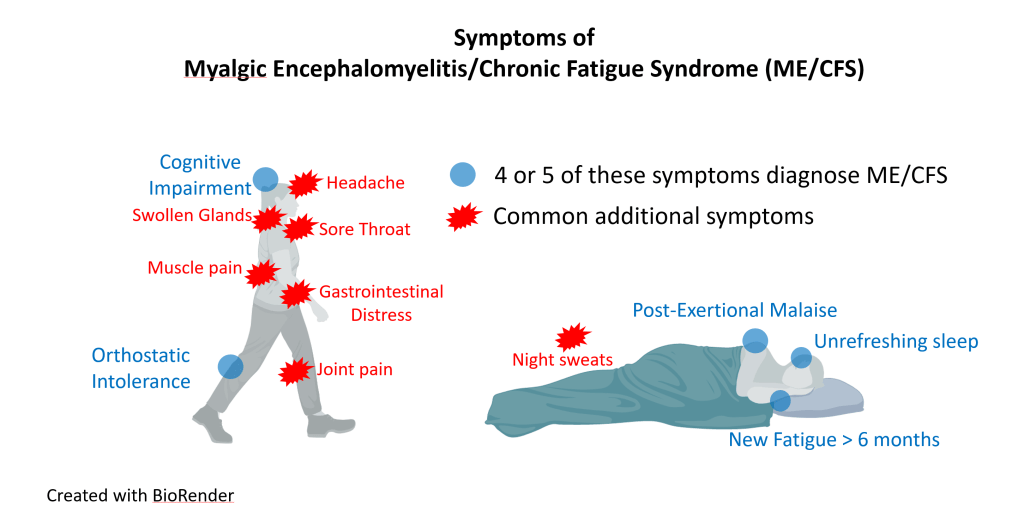
To geek out for a minute, because yes, I sometimes read medical journals, both share such clinical findings as “redox imbalance, systemic inflammation and neuroinflammation, an impaired ability to generate adenosine triphosphate, and a general hypometabolic state” and symptoms such as “profound fatigue, postexertional malaise, unrefreshing sleep, cognitive deficits, and orthostatic intolerance.1

Let me break that down for you in real talk.

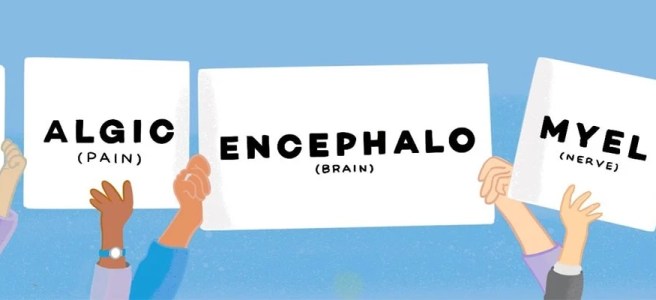
I will describe a generic day with Myalgic Encephalomyelitis, more commonly known as Chronic Fatigue Syndrome or ME/CFS. Oh and migraine. Because why not, right?

Buckle up, kiddies. Here we go:

Profound Fatigue

You wake up, but only because you have to. You went to bed on time. Early even, but it doesn’t matter. You turn off the alarm, pick up your sense of duty, and wipe away a thin sheen of shame because you need so much sleep.

You also peel your clammy PJs off, remembering half-waking in the night, drenched in sweat. Again.

It wasn’t always like this. You can dimly recall waking up and feeling ready for the day. Or was that a dream?

No matter. Today you get up and do your thing – whatever it is – because you have to. And because people don’t understand. But it’s OK. You can’t blame them. You didn’t, either, until it was your life.

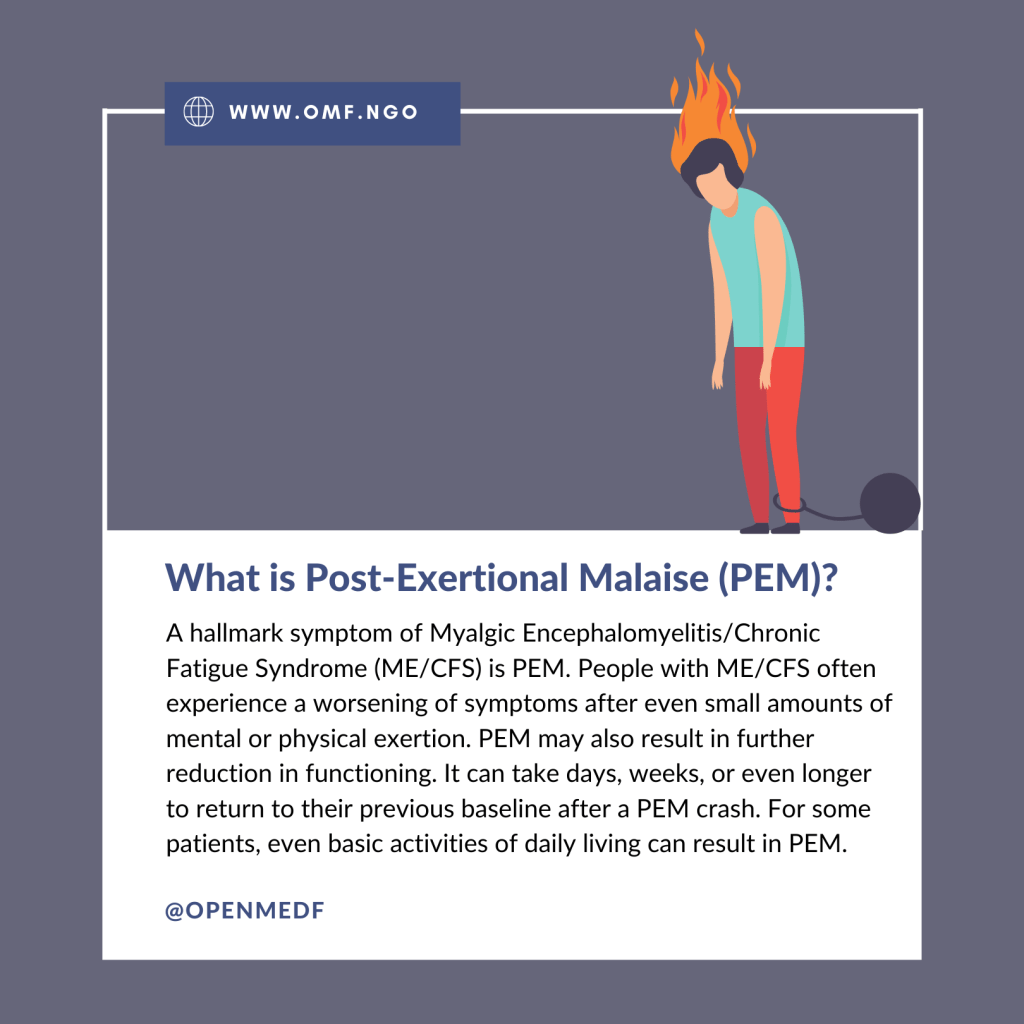
Postexertional Malaise

As you start your day, you think back to your gym rat days and the time when you did P-90X and were in the best shape of your life. You look at your once-chiseled arms as you dress and have a moment of missing the upper body strength.

Back then, you’d start every day with a workout. A brisk walk or run followed by some weight training. Fond memories of times when your body just moved well. Working out was fun; it was therapy.

Now you drag yourself to the yoga mat and hope you have the energy to do a 30-minute flow. But, you remind yourself, be thankful.

You are one of the lucky ones. Some people with ME/CFS can’t muster the energy for yoga. Or going to the grocery story. Or walking up stairs.

You have a part-time job and can even go for a walk a couple days a week. Sure, you have to constantly adjust because a little too much physical or mental effort will cause a crash. Then, there goes a weekend down the tubes. But at least you can still function reasonably well.

Still, as you go into the first downward dog and feel that odd sensation in your muscles that you used to associate with doing heavy reps to the point of muscle failure, you can’t help but miss the strength. It feels like your muscles are starving for something.

Because they are, you remind yourself. The ATP production is janky and there just isn’t fuel in the tank.

Hmmm. Three miles must have been too far to walk yesterday. You remember when 10 miles was nothing.

You say a prayer that the Lord will help you wake up enough to read your Bible without nodding off, and you know He will make it work out. If not this morning, later on today. He’s good like that.

Cognitive Deficits

You close your Bible and thank God for giving you the mental energy to actually read and understand today. Not every day is like this. You start your prayers and include one you forget most of the time:

Lord please help me to remember people’s names today. And words. And my lessons.

Your brain simply isn’t what it used to be. Of course, some of the cognitive issues started after the first go-round with meningitis and the resulting chronic headache condition. Thank you, Lord, that it’s no longer chronic.

Still, as a teacher, it can be awkward to get in front of your class and forget words. It makes you look like you don’t know what you’re talking about. Worse is when you can’t get a student’s name to come to the surface. You know this child; you’ve known her for years. The name is in there somewhere. But it seems buried.

It’s laughable to think you were once recognized for your memory. It was borderline eidetic. Being able to call up scenes, snippets, the pictures of numbers – that was handy. If you wrote it down, you could remember it because you could call up the image of your writing. You could recall scenes, like having a video playback inside your head.

Now when you reach for a memory, it may or may not be there. You wonder if this is what it feels like to lose a limb. By habit, you go to put weight on it or reach to pick up a glass but there’s nothing there. You say a prayer for people who’ve lost limbs.

Then you remember your Mammaw who had severe dementia and say another prayer that the Lord will take you home before your mind goes so your kids don’t have to go through what your Mama did.

To be continued…

1PNAS article