Homeschool Advice Part 3 | Getting Started

Besides three myth-busting posts (1, 2 & 3), I’ve also offered two other posts’ worth of advice just prior to this one. However, before we go much further, I want to offer encouragement to the possibly nervous prospective homeschooler. Let’s face it: taking your kids’ education into your own hands can be daunting. If you’re like me, you may tend to drown yourself in what-ifs or start worrying about your ability to teach Algebra 2 before your little one has even learned the alphabet. If this is you, allow me to offer a little advice for getting started.

You Will Grow into It

For starters, you are not required to homeschool all the grades right off the bat. Whether you start in Kindergarten or you’re pulling your middle schooler out of a toxic environment to homeschool, the good news is that you will start where you are and grow into it. Don’t worry about the next step, but keep your mind on what you need to do today. God will give you the light you need for where you are now. Learn to live and thrive right there, trusting Him for what’s next.

Your word is a lamp to my feet and a light to my path.
(Psalms 119:105)

A friend of mine likes to comment on this verse by saying the promise is for a light for our path, not a floodlight to illuminate the whole journey. He’s not wrong. God will give us what we need when we need it, and sometimes just in the nick of time.

Don’t forget, God’s call to homeschool may or may not be for the duration of your child’s education. I thought I would homeschool until college, but the Lord had other ideas. The year before my kids went to private school, I couldn’t have imagined us being able to afford it. Yet when God wanted them to go, He provided – and they went.

With this in mind, I encourage you to seek the Lord each year to clarify what’s next. If He calls you to teach your own all the way through high school graduation, you can trust Him to provide the necessary tools or people in your life to fill the gaps in your own ability. With resources like homeschool co-ops, tutorials, personal tutors, Khan Academy, and more, you are definitely not alone in the journey.

So my friend, don’t worry about how you’ll teach Finite Mathematics or Physics to your five-year-old. Focus on what you need to teach your children today, and trust the Lord to provide the light for the next step if and when you need it.

You Are the Parent

Folly is bound up in the heart of a child, but the rod of discipline drives it far from him.
(Proverbs 22:15)

When it comes to the actual fact of doing school, it’s important to remember that your child is not in control. This may be an unpopular opinion, but I vehemently despise unschooling for the very reason that it is nothing more than lazy parenting wrapped in a cutesy label. There are foundational subjects that must be learned in order to become a functional member of any society.

Indeed, subjects such as basic math, reading comprehension, and critical thinking are also vital for a person’s own protection against manipulation from a variety of levels. And it’s up to you, the parent, to enforce this learning.

Is it difficult? Yes! Absolutely. Parenting is not always easy, and homeschooling is basically non-stop parenting with a side of reading, writing, and arithmetic.

Your kids will push your buttons. They will wheedle and whine and try to distract you from getting to school. They will pretend to be sick; they will take forever to eat breakfast; they will drop their pencils 87 times and take a full minute to pick them up each and every time.

You will have days where you feel outnumbered (because if you have more than one child, you are), and you’ll have days where you find yourself casually perusing the intake forms at overseas boarding schools.

But if you are called, don’t give up. Pray without ceasing, take a deep breath, and remind yourself: you are the parent, and by God’s grace, you can do this. Then, soldier on.

You Are the Teacher

When your children complain that they hate math or despise reading, tell them it’s OK – it’s actually good for us to do things we don’t enjoy! I used to tell mine, “I totally understand. I hate cleaning toilets and I don’t really feel like cooking dinner tonight, but I’ll bet you’re glad I’ll do it anyway.”

Don’t be deceived by the homeschooling catalogues that show smiling children, eyes filled with wonder and eagerly tackling their subjects while mom beams down with unruffled hair and pride. You may have a golden day or week, but much of homeschooling is far more like trying to get chores done well, only these chores make a difference whether your kids have a firm educational foundation or not.

It’s your job as the teacher to facilitate learning in the best way you know how. Teach to the best of your ability. Ask God – daily – for wisdom on how to teach. He will give you ideas on how to get topics across to your kiddos if you just ask, so ask away. But most of all, keep your expectations of your homeschool, your children, and yourself in reasonable bounds.

Part of being the teacher is setting and keeping priorities. And you know what? School is a priority. I’ve already written about keeping God’s Word and prayer first. Second should be the hard work of school, no matter what else.

Here’s the thing about homeschooling: there are a bazillion distractions. There are a ton of fun things to do, places to go, field trips to take, social opportunities to indulge. All these are good, but they can quickly overtake time you need for the basics of grammar, reading, and math. It is vital to set school hours and keep them as stringently as possible, even if there are necessary interruptions like sickness and doctor’s visits.

This not only establishes your homeschool as a priority, it teaches kids how to prioritize work over fun and prepares them to be self-disciplined. With the amount of work-from-home options available today, it may also give them skills needed for a future career.

School Is a Priority for You, Too

And mom or dad? This means for you, too. School hours are just that – for school. Resist the urge to space out and play games on your phone while your kids pretend to do work. Stay engaged and keep them on task. Imagine how outraged you’d be to find out your child’s school teacher was scrolling Facebook while the class did whatever they wanted, and hold yourself to the same standard.

Remember, homeschooling is still a job even though it doesn’t bring an income. Keep in mind your “boss” is no less than the Almighty God, so treat His calling with the diligence you would a career (or more so) despite the lack of pay.

After all, the privilege of participating in shaping the minds of the future, while it may not make you wealthy or well-known on earth, will honor God and become a part of your eternal inheritance – an inheritance that will neither fade nor fail.

Whatever you do, work heartily, as for the Lord and not for men, knowing that from the Lord you will receive the inheritance as your reward. You are serving the Lord Christ (Colossians 3:23-24).

Homeschool Advice Part 2 | Prioritize Scripture & Prayer

The single most important item you will teach your children is to know and love both God’s Word and its Author. Because all we have comes ultimately from Him, start with prayer. And start with you – learn to spend daily time reading your Bible and talking with God about what He is showing you, even if at first you do it only because you feel you must. Ask Him to open the Word and help you love it, and He will!

When it comes to your children, Scripture training is vital. I’m not saying other subjects are unimportant. Indeed, math, grammar, and reading will lay a firm foundation for further learning, and extra-curricular activities can enhance life.

However, when it comes to setting priorities, I like to use what I call the 100 Year Rule. When making decisions on using the time you have, think about what will matter 100 years from today – not to mention the impossible-to-imagine stretch of eternity beyond. (Hint: it’s what we do for the love of the Lord, and His Word is the tool He’s given us to increase our knowledge of Him).

The grass withers, the flower fades,
    but the word of our God will stand forever (Isaiah 40:8).

The best way to pass on a love for God’s Word is to model it. You cannot pass on what you do not have, so if you do not have a Psalm 119 love for the Bible, pray for it. Ask the Lord to give you and your family a hunger for His Word and wisdom to understand it.

Oh how I love your law! It is my meditation all the day (Psalms 119:97).

Then, make the Bible the first thing you read together in the mornings. Memorize it. Take turns reading it aloud. Talk about it. Let the Word of God become a natural topic in your home, and point out how it shows up in daily life. Pray for eyes to see God’s Word in action so you don’t miss it. Pray for understanding of hard passages, for wisdom, for insight; pray for it to become the words of life for you and your family.

And these words that I command you today shall be on your heart. You shall teach them diligently to your children, and shall talk of them when you sit in your house, and when you walk by the way, and when you lie down, and when you rise (Deuteronomy 6:6-7).

Even while you prioritize time in the Word, don’t neglect to pray fervently and constantly for the hearts and minds of your children. Ask the Lord to do what you cannot and draw them to Himself, to grant them saving faith in His Son Jesus, to give them the Holy Spirit to be their Guide. Pray they will truly love the Lord their God with all that they are.

In all you do, keep eternity in mind and remember that eternity may go on forever, but it begins right now. What better time to start preparing for it?

Homeschool Advice Part 1 | Self-reliance

Now that I’ve covered three of the most prominent myths of homeschooling (here, here, and here), it’s time to dive into what I’ve learned from my own homeschool experience. The next several homeschool posts will be advice I’d give to myself if I could have a do-over, including rejecting the lie of self-reliance.

But before I continue, note two important facts. First, I am offering homeschool advice from the perspective of a former homeschooler whose children are now in college and nearing graduation. I’ve been deeply immersed in the homeschool community as well as worked for two years at the private Christian school where my three attended for the high school years. I have friends who currently work in public schools and attended public school myself back in my school days, so my perspective is not one of a limited, narrow focus.

Second and probably the most important, I advise from a Christian perspective. I cannot offer any insight outside of Christ because my life is wholly wrapped up and defined by His. I first truly understood what He did for me at the age of 26, and since then I have grown so close to and dependent upon Him that I cannot even fathom offering advice apart from the God I serve. There is my disclaimer; do with it what you will.

That being said, let’s begin.

You Are Not Enough

I know our culture likes to pad up our egos with sweet little lies like: you are enough, you can do whatever you set your mind to, and you’ve got this.

The problem is, all this self-reliance is absolute rubbish. At the risk of sounding negative, I promise you will discover how hollow and futile such empty adages are if you homeschool. However, the understanding that you are not enough is actually good news! Hear me out.

If you are convinced in your own enoughness, how devastating will it be when – and yes, I did say when – you fail in some regard. You are human, and humans are all distorted by sin and fallible. If you are enough, you are depending upon a broken instrument to instruct your young.

The actual truth is: you can’t do this. But God can.

He who calls you is faithful; he will surely do it (1 Thessalonians 5:24, ESV).

Learn to accept that you are not and never will be enough, not for yourself, your spouse, or for your children. You will have moments of failure. You will lose your temper. You will have bad days. You may find subjects that came easily for you do not come easily for your children, and you may struggle to translate concepts that seem obvious to you into terms they can comprehend. You will have doubts and struggles and failures.

You most certainly are not enough, so breathe a sigh of relief and choose to seek the God who called you to homeschool and learn to rely – daily – upon His infinite well of wisdom and resource.

And take heart in the fact that sometimes failure is part of learning well – both for you and for your offspring. More on that later.

Pray without Ceasing

The best way to reject self-reliance is to learn to think of your day as an ongoing conversation with the Lord who called you and who guides you. Imagine the Holy Spirit as the director of your school, if it helps, and call on Him for advice when you run into a discipline issue or a problem you can’t solve. Ask Him and wait for His lead. I promise He will not steer you wrong, although if you’re like me, you might run ahead of him because you feel you don’t have time to wait.

Which, for the record, I do not recommend.

He will give you what you need, so ask Him and trust Him. Resist the urge to look to other sources for wisdom, because if God called you to homeschool, He alone can determine the right course of action for your specific call.

I am the LORD your God, who brought you up out of the land of Egypt. Open your mouth wide, and I will fill it (Psalm 81:10, ESV).

Don’t Fret over Your Weakness

When you feel weak, insecure, unable to teach, incapable of parenting 24/7, and frustrated with trying to play the roles of parent, teacher, counselor, principle, curriculum coordinator, and administrative assistant all at the same time, don’t worry. Instead, rejoice – difficult though it may be – because where you are weak is where you get to see God’s power shine.

But he said to me, “My grace is sufficient for you, for my power is made perfect in weakness.” Therefore I will boast all the more gladly of my weaknesses, so that the power of Christ may rest upon me (2 Corinthians 12:9, ESV).

It’s a challenge to feel weak, inept, incompetent, but I can tell you from the other side that it is good.

My homeschool career was complicated by chronic intractable migraine with status migrainosis- a diagnosis I did not acquire for at least a decade. During stated decade (or more – time was fuzzy then), I suffered with daily headaches ranging from distracting to debilitating. I saw numerous doctors, some of whom didn’t believe me.

I also tried a number of medications, occasionally getting the number of headache days down to 20 or fewer per month before my body would adjust and a dosage increase would be required. Each of these medications brought side effects, and none of them served to improve my quality of life.

My poor children had to deal with migraine-brain, migraine prodromal rages, me fleeing to the bathroom to vomit in the middle of a lesson, and even passing out on the schoolroom floor.

Yet where I was weak, the Lord was strong. I truly couldn’t have done it in my own strength, but by God’s grace, my children learned both academics and compassion.

God truly is good.

Spammity Spam

Fun fact: the term spam as it is used to describe junk email (among other internet delights) has its origins in a 1970s British television show. Monty Python’s Flying Circus was an oddball sketch comedy series featuring sometimes bizarre animations, entirely random and quirky subject matter, and often men badly dressed as women.

Indeed, the sketch titled “SPAM” features a man and woman lowered from the ceiling into a cafe where Vikings dine in the background and the proprietor reads the menu filled mostly with items containing various amounts of the tinned meat – including the final item, “Lobster thermidor aux crevettes with a mornay sauce garnished with truffle paté, brandy, and a fried egg on top and spam.”

And often, the repetition of the infamous canned mystery meat sets off a Viking chant in praise of Spam.

Why do I bring this up?

The more I see blatant lies go unchecked, unchallenged, and uncorrected in both media and society – and perhaps especially so as an election looms – I can’t help but feel as if the entirety of our news & entertainment industry is busily shouting, “Spam, spam, spam, spam, spam, spam, spam, spammity SPAM! Wonderful SPAM!” while we, the weary public, are just trying to hear what’s on the menu.

Even when we do manage to hear a word through the cacophony of deceit, we’re disheartened to learn all our options contain varying degrees of hyper-processed pork. We can have a little SPAM or a lot of SPAM; we may even choose a culinarily excellent dish with a bit of SPAM, but we cannot entirely escape SPAM.

And you know what? I don’t like spam.

I’m just glad my hope is not in the outcome of this election nor the sanity of my fellow Americans. Either way, I can no longer check an increasing certainty that the last days of the world are rapidly speeding by.

The coming of the lawless one is by the activity of Satan with all power and false signs and wonders,
and with all wicked deception for those who are perishing,
because they refused to love the truth and so be saved.
Therefore God sends them a strong delusion so that they may believe what is false,
in order that all may be condemned who did not believe the truth but had pleasure in unrighteousness.
(2 Thessalonians 2:9-12)

But friends, you do not have to toe the party line nor give into the delusion. There is a better Way. His name is Yeshua, known more commonly as Jesus.

For the grace of God has appeared, bringing salvation for all people, 
training us to renounce ungodliness and worldly passions,
and to live self-controlled, upright, and godly lives in the present age,
waiting for our blessed hope, the appearing of the glory of our great God and Savior Jesus Christ,
who gave himself for us to redeem us from all lawlessness
and to purify for himself a people for his own possession
who are zealous for good works.
(Titus 2:11-14)

It’s not too late to join those of us on the narrow way that leads to life! All are welcome, though not all choose it. I would love to talk to you more if you have questions; feel free to reach out.

Homeschool Myth #3: Socialization

I’ve already covered two other prevailing myths (here and here) about homeschooling, and I plan this to be the final myth-busting post.. at least for now. After today, the focus will shift to sharing what I’ve learned – both triumphs and failures – in hopes that others can glean wisdom from both. But now, time to tackle the most pervasive myth I’ve encountered: the myth that homeschoolers lack proper socialization.

Even with the mainstreaming of homeschooling in the post-pandemic world, this strange stigma still persists. If this is a fear holding you back, allow me to speak rather passionately on the absurdity of this particular fiction.

1. Kids Don’t Attend School to Socialize

For those of us who grew up in public school, we already know how much trouble a kid could get into for talking in class. Teachers are there to teach, not to facilitate social hour, and I know from personal experience how frustrating it is as a teacher when your students ignore the material and focus on Jenny’s new boyfriend or Joey’s new dog. Class time is meant for learning, not socializing.

Of course there’s the 25-30 minute school lunch break, offering students enough time to line up, march through the cafeteria line, scarf down their partly-burnt, partly-frozen pizza, and hope to beat the rush to the bathroom before heading back to class. In this little window, kids do have a chance to talk while eating, but there certainly isn’t time to really flex those social muscles.

In fact, most of social time in a school setting (public or private) happens after school hours during extra-curricular activities. Activities, I may add, that are not exclusively available to public or private schools.

Then there’s the social time between classes in hallways, but as any public school veteran knows, these times are often dominated by cliques, bullying, or hiding from bullies.

To be blunt, public school does not guarantee a good handle on social situations. A broken family, autistic tendencies, tragedy, abuse – there are many factors that contribute to a child’s social well-being or lack thereof. While there are opportunities in school for children to learn group dynamics, these opportunities are not limited to schools.

A school is not the only place one may develop robust social skills. Even in the best cases, a school setting (again, public or private) still fails to provide a real-world social environment, bringing me nicely to the next point.

2. Schools Are a Social Anomaly

In the workplaces of the world, it is incredibly rare when an individual works exclusively with a group of peers whose birthdates are within approximately 13 months or so of his own. Unless you’re an entrepreneur working with a select group of pals developing a niche start-up, your co-workers span several decades and represent a variety of generations.

In fact, there are very few places where people socialize only with other people the same age as them, schools being one. The reason for this is the modern mass-education approach to schooling that is not dissimilar to an assembly line.

Kids of a certain age are developmentally able to handle certain information, thus we group them accordingly and stick the bits of info in at key points as they travel along the assembly line. This mass-production approach only serves to reinforce my first point. While it may be an OK way of passing on knowledge (as opposed to a good method), the type of socializing it provides for does not prepare children for real life situations.

Homeschooled children, on the other hand, frequently interact with people of all ages. Because they often go along on errands, they can learn to speak to retail clerks of all ages. With the popularity of homeschool coops and group events, homeschooled children have the privilege of mixing with a variety of ages and stages outside the classroom setting. And because homeschool parents are generally involved, there is much less room for bullying, predatory actions, and other unpleasant social behaviors.

Even when they were quite young, my children and their friends were comfortable talking to adults. We did our best to make them aware of the dangers of trusting unknown adults, of course, and I was always at hand for such encounters. But it was wonderful to watch them ask questions of the volunteers at the aquarium when we visited or get a little more in-depth look at blacksmithing or soap making from the booths at a local history fair because they did not hesitate to ask. The workers at such events often delight in sharing their knowledge, creating a beautiful win-win.

Granted, it is possible to homeschool and cloister one’s kids away from the world, but this is a choice; a choice you do not have to make if you choose to homeschool. There are plenty of opportunities for homeschool kids to develop social skills, as we’ll discuss next.

3. Homeschool Social Opportunities Abound

There came a point in my homeschool journey when I realized it was quite possible to allow my brood to spend the entire school day socializing. There were field trips and clubs; PE classes and nature walks; mock governments and good, old-fashioned playdates galore. I confess I began my homeschool journey concerned about them socially, but this concern was quickly dissipated.

In fact, after the first year, the last thing I worried about was socializing. They had plenty of that. Rather, I had to guard our class time like the crown jewels in order to keep social hours from trumping math and grammar.

If lack of socialization is a fear of yours, don’t let it stop you from homeschooling. Instead, set yourself to prioritize learning time so the social element can be a reward rather than a key focus. Socializing comes easier to kids than algebra, after all, so don’t sweat it.

Besides, there are some social elements you probably don’t want them to get drawn into.

4. What about Amoral Societies?

Socialization (noun): the process beginning during childhood by which individuals acquire the values, habits, and attitudes of a society (Source: merriam-webster.com).

Let’s not overlook the fact that not all socialization is positive. Kids want to conform to what is seen as “normal,” but for a true disciple of Christ, this is a problem.

Do not be conformed to this world, but be transformed by the renewal of your mind, that by testing you may discern what is the will of God, what is good and acceptable and perfect (Romans 12:2).

From a cultural standpoint, “normal” is nebulous, and it does not always line up with biblical truth or the design of the Designer.

At a not-too-distant point in history, American “normal” lined up fairly well with biblical values – even if the underlying motivations were different. There was at least a clear distinction recognized between right and wrong as well as a social stigma for crossing that line.

You really don’t even have to fast forward to see the change, it happened so quickly. We’ve cast off many of our former restraints. Now we live in a cultural moment where individuals decide what is good or bad.

Live your truth has replaced the idea of an objective standard of good and evil, fragmenting the very ideas of right and wrong into infinitesimal and uncountable splinters that no longer have a cohesive social whole.

And that’s just one aspect. There are so many more. Drugs. Racial hatred. The alphabet soup agenda. Political propaganda spoon-fed to kids too young to understand politics. The bizarre ideas that what’s true for you might not be true for me or that two parties cannot disagree and still get along.

With all this chaos dancing in the social sphere, the question becomes, “Do I really want my child to fit in to this social realm?”

Of course, homeschooling will not shield your baby from all of it. The fact is, whether we homeschool or not, we will have to walk our children through reality in a way neither we nor previous generations had to.

However, in homeschooling, you do have the privilege of controlling the environment just a bit more. You stand at the gates and can allow the issues to trickle in one-by-one or in pairs, tackling each one as it arises or introducing it when the Lord leads you to.

It’s not a perfect system, but we live in an imperfect and fallen world. Thanks be to God, He has sent us a perfect Savior to rescue us from our own evil hearts and given us His Spirit to be our Guide! With His help, you can guide your young ones socially as well as academically.

Homeschool Myth #2: You Need a Degree to Homeschool

Oh how I love your law! It is my meditation all the day. Your commandment makes me wiser than my enemies, for it is ever with me. I have more understanding than all my teachers, for your testimonies are my meditation
(Psalms 119:97-99).

Though homeschooling is even more mainstream than it was in my time, the decision to homeschool will always bring with it a barrage of well-meaning concern from others. Often, many of these concerns stem from homeschooling myths. In a previous post, we discussed the myth that homeschool parents must possess a bottomless well of patience. Today I want to address another myth you are likely to encounter, especially if – like me – you never obtained a college degree.

In fact, if you lack a college degree, be prepared to face withering criticism from others who believe only a degreed teacher is adequate for the task of teaching children. Or your own insecurity over the lack may rise up to confront you (it did me!). Face it, but don’t let it get to you.

Even if you do have a degree, doubts may still linger. Especially if your degree isn’t related to teaching, maybe it’s in mechanical engineering or marketing, you may fear or be told those skills are not transferable to homeschooling. This post is for you, too.

In answer to all of the above, I offer that no school or textbook training can prepare a person for the actual work of teaching your own children. Even for the trained teacher, classroom teaching is quite a different animal than homeschooling. If you’ve been called by God to homeschool, I urge not to allow naysayers or self-doubt cause you grief.

A call to homeschool is not given by a college nor by well-meaning critics; it is given by God. He is the One to please with your efforts, He is the only One who can prepare you to do the work He calls you to, and He alone is the appropriate Judge for the outcome.

With that in mind, let’s peek into this myth.

Myth: Only Degreed Teachers Can Teach Properly

Respectfully, no. Just no – although I suppose I ought to elaborate.

While i admit it may be useful in the high school years to have specialized training – especially for higher-level mathematics or sciences – the vast majority of subjects in elementary through high school learning are easily accessible to the average human being. And as for elementary school – well, it is elementary; by definition “straightforward and uncomplicated.”

As for those higher subjects, you have picked a wonderful time to homeschool. In today’s world, there is a veritable smorgasbord of resources both for teaching and learning everything from basic math to ancient Hebrew. Historically speaking, this is a beautiful time to homeschool. Even if you are utterly incapable of teaching the high-level material, you can find a tutor, an online class, or even a dual-enrollment college course to fill the gap. Don’t let fear of high school calculus discourage you!

But for those who insist a person must have the training afforded by a degree in order to teach, I present Exhibit A.

Exhibit A: The Case of the Mistaken Teacher

When I was just beginning my homeschool journey, a public school teacher in my circle vocalized strong doubt in my ability to teach my kiddos elementary math and grammar without a degree. In the same afternoon, this person shared a tale when a student corrected a geography lesson – a lesson the person had been teaching (incorrectly) for several years. The pre-pubescent student was right, and the college-educated teacher erred.

My point? Acquiring a degree does not confer infallibility. Nor does the time, money, and effort spent in obtaining a degree magically bestow intelligence or aptitude upon the recipient.

There are tons of brilliant humans with the proper papers in frames on their wall and a string of letters after their signature. However, I submit to you that there are also incredibly… disappointing… humans with precisely the same trappings.

I know both homeschoolers and classroom teachers with and without degrees who are absolutely amazing teachers. I also know people in both positions who, quite frankly, stink at their jobs. Thus my argument is neither for or against college degrees. It is merely against the stipulation that a degree is required for a successful homeschool.

Degrees Are Not Guarantees

So, is a degree helpful in homeschooling? The best I have is – maybe.

Assuming you’ve not yet paid off your student debt, a degree may even present an obstacle to homeschooling. Homeschooling is a full-time job where you purchase curriculum rather than earn salary so you won’t recoup the cost of a degree, if that’s what you mean.

College training may enable you to tackle certain high school subjects with greater confidence. Then again, by the time your children arrive at that stage of learning, you may have forgotten it anyway. Or your knowledge could be out of date.

Or you may be too busy trying to pay off your student debt to really focus on teaching the high-level material. With this in mind, I submit Exhibit B.

Exhibit B: The Case of the Unlikely & Untrained Teacher

Due to what amounts to a mental health crisis in my late teens and early twenties, I never completed my degree. I had a 4.0 for my one shining semester of college, yet I allowed choking despair and financial fear to dictate my decisions and did not return.

Fast forward to the moment the Lord called me to homeschool. I was fabulously impatient, had an anger problem, and suffered from debilitating chronic migraines (which eventually became intractable) beginning in my son’s kindergarten year and continuing through most of my homeschool days.

Not exactly a recipe for success.

Nevertheless despite my inadequacies, God did call me and I did obey, even managing to educate my three children quite well (though not I but Christ in me).

Did I do it perfectly? Unequivocally no. I made gobs of mistakes, and I plan to share many of them with you on this blog so you can learn from my failures. However, by God’s grace I did many things right as well – often quite by accident. These I will also share in future posts.

Despite my glaring lack, all three of my kids had no trouble assimilating into a private high school when my husband decided to make that transition in their high school years, nor was college a problem.*

Yes, it’s true they acquired higher-level learning before college from the private school, but the foundation was well-laid – NOT by me but by the incredible mercy of a God whose power was made perfect in my weakness (and in my degree-lessness). This is no boast of my own efforts but presented as proof of what the God who called me was able to do despite my lack of training or credentials.

The Best Way to Teach Properly

In short, whether you have a degree or not, you will make mistakes.

A degree does not serve as a barrier against human fallibility. Trained and experienced teachers make mistakes, and so will you. Don’t use this as a copout for a lack of diligence, but don’t let it become an obstacle you fear, either. Instead, learn to embrace mistakes and learn from them. As I always told my kids: never waste a good mistake.

So if you don’t need a degree to homeschool, what do you need?

I posit the greatest need is a vibrant, healthy, and active relationship with the living God whose power is perfected in our weakness – along with humility. You won’t have all the answers, but you will have the wonderful opportunity to show your kids how to do the leg work to find the answers – a far more rewarding process in the long run.

You also have the privilege of encouraging what a degree cannot impart either to you or your kiddos: a love for learning (and hey – model it if you really want to get the message across). Daily invite God in to find and fill the gaps. If He has called you, He will guide you through it as well – albeit often with just enough light to see the next step.

But don’t think your obedience will guarantee you’ll churn out the next Einstein or Charles Spurgeon. God is faithful, but His purposes for your children may be less flashy than your dreams for them. I learned this the painful way.

What I want you to take away is that you can trust the God who called you to homeschool to complete His purposes through your efforts, no matter how many or few credentials you have.

*DISCLAIMER: This is not entirely true. One child struggled in college due in part to the pandemic but more to acquiring a bad habit of sleeping through school and making As in high school – a fact I was highly displeased with when I discovered it during his senior year. Until then, I’d wrongly believed I was paying for him to learn accountability, among other things! In this particular case, I feel strongly said child would have been better served by homeschooling through high school, as I would have dealt out consequences for sleeping in class and forced better study skills in the process. But that’s neither here nor there.

Staying the Course

During my youngest daughter’s high school cross country career, I quickly learned it was no sissy sport. On the best days – cool and lovely ones – the team seemed exuberant, almost giddy after practice and I enjoyed their high spirits, gaining insight on the term runner’s high by watching them interact. But on brutal race days in the late-summer Tennessee heat, my cross country kiddos told me the only thing that helped them stay the course was knowing there was an end and a healthy fear of Coach.

And several of those races were grueling. Runners often finished their race lighter in body weight than they began it – not only from lost water weight due to heavy perspiration, but also because many of them lost the contents of their stomachs along the way. Watching them, I can only imagine what it feels like to run a marathon.

I think this is why Paul likens following Yeshua (Jesus) to running a race. There are moments where everything is working together in glorious rhythm; legs pumping with vigor, breath coming steady, and strength coursing through every atom. The cool air is a caress and the course a feast for the eyes.

Therefore, since we are surrounded by so great a cloud of witnesses, let us also lay aside every weight, and sin which clings so closely, and let us run with endurance the race that is set before us… (Hebrews 12:1)

But then there are those other days; days you’ve given your all, yet there’s more running to be done. Much more. Behind you on the course lie the remnants of all you hoped would bring nourishment and strength, now only waste. You’re bone weary and your very soul aches. The course is tedious and stretches on without end, cruel, unforgiving. You keep going because you know there is an end, and a healthy fear of the One who set you on this path pushes you on.

I know it’s like that for me at times. This race – the Christian race – is no 5K but an ultra marathon. It starts the moment you surrender to the Lordship of the Christ and continues until He calls you home. There are moments of unspeakable, exquisite beauty and moments of equally exquisite pain. At times, you run in harmonious fellowship, and at times you run alone – alone, that is, save for the One who sustains you by His grace.

There are high peaks and deep, dark valleys. There is pleasure and pain and loss. And yet, you run because you know the One who ran this course before is worth more than the sum total of your breath and being and experience and everything. Far more.

At first, you probably run for yourself, but as the kilometers fall away, you learn to run for Him. He is the goal; He is the very great reward.

He is the One who endured an anguish so intense, it cannot be expressed in mere human terms. His life sets you on fire; His suffering would have ended you many times over, the weight too staggering for a frail human vessel to contain. Yet He did contain it, drinking the brimful cup of righteous wrath to the bitterest dregs.

You run because you know He ran the course before you and knows every punishing hill and ankle trap.

You run, not for glory nor any feeble trophy, but for the King of kings and Lord of lords who endured the curse of humanity so those who love Him might find endurance to continue even when their strength is spent.

… let us run with endurance the race that is set before us, looking to Jesus, the founder and perfecter of our faith, who for the joy that was set before him endured the cross, despising the shame, and is seated at the right hand of the throne of God (Hebrews 12:1b-2).

You run for Yeshua and for the crown of life He promises those who love Him and who are faithful even to death.

I know it’s hard; it’s hard for me, too. It was harder for Him who had so much more to leave behind even to be born as a human. When I feel like giving in, I reflect on how much more He suffered to die as an outcast, scorned by the creation of His own hands.

So, keep running, friend. Don’t let the length of the course nor what you’ve left behind discourage you. Let it go, and be lighter for it. Press on for the upward goal, staying the course because you know there will be an end and the One you run for is worth far more than you have to give.

That’s what keeps me going. May it keep you as well.

Not that I have already obtained this or am already perfect, but I press on to make it my own, because Christ Jesus has made me his own. Brothers, I do not consider that I have made it my own. But one thing I do: forgetting what lies behind and straining forward to what lies ahead, I press on toward the goal for the prize of the upward call of God in Christ Jesus (Philippians 3:12-14).

I write this, not because I’m running well but because I need the reminder for a torturous stretch of my race. Stay the course.

Homeschool Myth #1: You Need Limitless Patience

I don’t Have the Patience

“I could never homeschool. I don’t have the patience for it!” Thus goes the most common refrain I heard from other parents when they first learned I homeschooled – back in the day, of course (my kids are all now in college).

My reply never varied. “Neither do I!” I would exclaim.

Homeschooling has been called “parenting on steroids,” and it’s true. A homeschool mom or dad is with the next generation 24 hours a day, 7 days a week, with no weekends, no planning periods (at least not in my case) and you’ll often boast an entourage when you visit the necessary room. You’ll have every button you own pushed (including many buttons you didn’t know existed), you play the roles of both parent and teacher, and you will have every grain of patience tried, tested, and expended – often before 9:00 a.m.

Yet you do NOT need a limitless amount of patience. What you DO need is a vibrant relationship with the Most High God. He is the Giver of all good gifts, and that includes patience. Instead of needing to be able to rely on your own strong & stalwart patience, you need to live in surrender to His Holy Spirit daily, hourly, so the fruit of patience can grow in you.

But the fruit of the Spirit is love, joy, peace, patience... (Galatians 5:22a, emphasis mine).

Patience Is a Fruit

Don’t miss this: since patience is a fruit, we must remember fruit takes time to grow and mature. Patience is not a prerequisite for beginning a home school; it is a fruit cultivated as you walk through the process. And it is worth the labor to cultivate.

Will you fail? Absolutely. But I would argue it is actually good for you children to see past a carefully-curated, self-reliant, perfect-but-false image and instead watch the process of sanctification unfold in a real human being.

In fact, I see it as an advantage to homeschooling that your children have a front-row seat to watching you deal with your emotions, frustrations, and become impatient with them. It’s good they get to see you deal with stress inappropriately and repent, get back up, and keep going. It’s a lesson like no other when your young ones watch you lose your cool and learn that the world does not shift off its axis and career through space like an oversized ping-pong ball when a human being fails to respond to stress in perfect patience.

It is also good for children to learn that patience is developed over time so they know that they, too, will be afforded the opportunity to develop patience rather than carrying the weight of being expected to handle every bump with perfect composure the first time around.

When they see you fail, get up, dust yourself off, and keep going, they learn to do the hard work of moving through failure and sin to a place of repentance and renewal. Not to mention perseverance; that gem of a virtue which is so lacking in modern society.

Impatience Is Human

But of course, we are a notoriously impatient species. Just think of what happened to the fledgling nation of Israel when their leader Moses took a bit over a month in meeting with the Almighty and bringing back the tablets of His covenant. Rather than taking it as a good sign when they saw God’s glory remaining on the mountaintop, the restless horde decided to chip in their varied jewelry and make a trinket to worship. Impatience isn’t a modern problem; it’s a human one.

When the people saw that Moses delayed to come down from the mountain, they people gathered themselves together to Aaron and said to him, “Up, make us gods who shall go before us. As for this Moses, the man who brought us out of the land of Egypt, we do not know what has become of him: (Exodus 32:1, emphasis mine).

Would it be convenient if God called us to do hard things like homeschool and just bestowed upon us a wealth of patience, wisdom, and genius right off the bat, making us supernaturally perfect at the job at hand? Of course it would be convenient. But it wouldn’t build our relationship with Him as we learn to come and ask for our daily bread – or daily patience – and rely utterly on Him.

Trusting God to Fill our Lack

My friends, more than God wants perfectly patient little children, He wants children who understand our aching need of Him and who depend on Him in relationship. The psalmist writes in Psalm 81:10, “I am the LORD your God, who brought you up out of the land of Egypt. Open your mouth wide, and I will fill it.”

This is what He wants for us in anything we lack – a heart that understands its own fallibility and a desire to ask our Father for what we do not have, trusting Him to give it.

In my homeschool days when my patience was tapped (as it often was), I learned to cry out to the God who always showed such patience with me. And more importantly than anything else, I learned that my God’s grace truly is sufficient and His power is made perfect in my weakness – just as He said.

Watching the Fruit Grow

So what is the fruit of this daily struggle to learn patience, to fail and get up and try again? For one thing, I am a far more patient person than I was when I began this journey.

Perhaps more compelling is what I see in my kids, all in college as of this writing. They did not turn out perfect, nor did I expect them to. But at the ages of 23, 21, and 19, they are absolutely amazing young people. They are delightful to be around, they make me laugh and we have real fun together. Really. I enjoy my adult children, and they astonish me with their wisdom, their grit, and their willingness to do hard things.

And would you believe it? Each one of them has more patience in their early 20s than I did even in my 30s and 40s. They are not perfect, but they are exponentially more impressive and enjoyable than I was a their ages.

Patience, it seems, is not only taught through personal trial but also passed on to your young as they participate in the process. Our God is just good like that.

So if you are thinking of homeschooling but fear you don’t have enough patience, allow me to set your mind at rest: you don’t. Instead, you have something far better – 24/7 access to the Father of Lights who loves to give good gifts to His children and is there with you through the painful parts of acquiring those gifts. And you also have my testimony that it is worth it.

I hope that helps in some small way.

4 More Reasons to Homeschool

Merely having an open mind is nothing. The object of opening the mind, as of opening the mouth, is to shut it again on something solid.

G. K. Chesterton

In the previous homeschool post, I discussed the #1 reason to go for it if you sense the Lord leading you to educate your own children. Today I want to look at four more solid reasons to homeschool. After this post, I’ll begin diving into more advice, hoping you can learn from my mistakes as well as glean wisdom from those things that, by God’s grace, I did well. 🙂 So without further ado, here are four more reasons to homeschool:

TO Equip the Next Generation of Christians

One key reason to homeschool is to truly equip the next generation for service to the Lord. Homeschooling puts one in a unique position to model a walk with God because your children will see you both at your best and at your worst. Thus, you will get plenty of opportunities to model not only diligent service to others, self-sacrifice, and humility; you will also have the chance to model repentance.

Trust me on this.

Also, the 24/7 nature of homeschooling means you get to walk out your faith in front of your children. They will see you prioritize your own time in the Word (which also gives you built-in accountability). You can point out to them the ways you see God at work in and around you, helping them to see Him as living and active and real.

Additionally, when your kids ask difficult questions from the Bible (and they will), you have the distinct privilege of clarifying your belief system in tandem with passing it on. It’s good for them to understand it’s OK not to know all the answers; it’s equally good to dig in together – researching and wrestling out those tough theological points with the Lord. Not only will your kids learn and grow, you will as well.

Follow the pattern of the sound words that you have heard from me, in the faith and love that are in Christ Jesus

2 Timothy 1:13

To Raise Functional, Godly Adults

A modern parenting myth is that parents should strive to raise happy children. I respectfully and vehemently disagree. Parents should raise God-fearing adults who are capable of resilience and stamina in a fallen world. Happiness will come and go, but “godliness with contentment is great gain” and actually assures eternal happiness that will far outlast the temporary highs and lows of physical life.

The aim of our charge is love that issues from a pure heart and a good conscience and a sincere faith.

1 Timothy 1:5

And to be frank, you do not really want your sweet ones to be permanent children. You want them to learn to do things for themselves; to try and fail and learn that failure is not the end of the world; to step out of their comfort zone and experience difficulty so they can see God really is with them in the valleys of deep darkness – and that the darkness has an end.

This means the goal of homeschooling should not be to coddle and shelter but to equip and prepare. Keep this thought in the back of your mind when you’re tempted to just give an A or let deadlines become negotiable or negligible.

Sure, your second grader may be sad if you mark a big red X on her math problem or your fourth-grader may have hurt feelings from your constructive criticism of his book report. But learning that their value is not derived from their performance is more important than temporary feelings. Not to mention how learning accountability, working to achieve goals, handling feedback, and dealing with deadlines and expectations will prepare them for things like jobs and bills and marriage and ministry and life.

And again, if I may be frank? God does not call His children to soft, pleasant pastimes. He calls us to take up our crosses daily and follow Him. It’s OK to teach this to your children. In fact, it’s recommended.

To Teach Your Kids to Think

And you shall love the Lord your God with all your heart and with all your soul and with all your mind and with all your strength…

Mark 12:30, emphasis mine

Let’s face it: our public school system has gotten so caught up in bureaucracy, it’s long ago lost the mission of teaching a generation to think. Instead, I would argue most schools nowadays teach kids WHAT to think instead.

Thinking is becoming a lost art. Don’t let it happen. Your kids need to learn to love God with all their mind, and you are in a position to help them become good stewards of those minds. When your kids ask for help with a problem or have a question, whether about school work or anything else, resist the temptation to tell them the answer. Instead, ask follow-up questions to help them think through it and arrive at the answer themselves.

Invite an attitude of exploration with the divining rod of God’s Word as your center. Dive into other worldviews and dissect them according to biblical truth. Dig into tough questions about faith, culture, or even the biblical text itself. Help your kids see that God is the Author of truth and that all truth leads back to Him.

Prepare them to think so when people spout memorized anti-Christian sentiments or cultural confusion (such as the current gender chaos) at them in college or the workplace, they will be ready to address them without fear but with confidence in the Lord who gave them a mind they are already accustomed to loving Him and others with.

Is this harder and more time-consuming? Yes. But it is absolutely worth it.

To Develop Lifelong Learners

A final reason is to develop lifelong learners, not just box-checkers. You can infect your kiddos with the joy of learning about this immense and fascinating world God made as well as the depths of the Infinite God who made it.

In a homeschool, learning isn’t confined to a classroom but seeps into every aspect of life. Children can participate from a very early age in caring for the home, learning skills like laundry and cooking, and even being a part of shopping and other mundane tasks.

Car rides and the lunch table become places where ideas are brought out and discussed. In fact, some of our most incredible teachable moments happened in the car. So resist the easy button of handing them a device to entertain and anesthetize them when you take that hour drive to a field trip. Instead, engage your kids in conversation even when they are little. This pays out big dividends in the teen years and beyond.

My three are in college, and I have THE best time talking to them still to this day. They are intelligent, articulate, and fascinating people, and I’m glad I stuck it out and engaged with them through endless trivia about Thomas the Tank Engine and friends or the battery of ten thousand questions before noon each day. Now when I talk to them, I’m often the one learning – especially in their respective fields of study (structural engineering, cellular & molecular biology, and kinesthesiology).

As Tim Hawkins says it in his “Homeschool Blues” song, “They say, ‘You think you can school your kids better?’ Pretty much!”

Homeschool Blues

Uneclipsed: When God’s Glory Intersects Our Story

I want to tell you a true story about the small-but-not-small ways God showed up during a recent trip. It really began a couple of years ago when I lined up a VRBO map and map of the path of totality for the April 8, 2024 eclipse. Already, bookings were slim around the major cities within an eight hour drive of my home, so I pored over the maps, sifted through rentals in obscure towns in search of a spot that met the following criteria:

  • Two bedrooms (my mama was coming with us)
  • Dog-friendly
  • Reasonably priced
  • A good view of the sky (i.e. – no tree cover)
  • As close to the center of the path of totality as possible

I found a cabin in Calico Rock, Arkansas that looked promising and booked it, hoping the online photos were accurate. At the last moment, an opportunity arose to leave a day early, and by the grace of God, all the loose ends fit. And a string of totally unmerited blessings commenced.

First, we arrived in the little town around 8:30 p.m., leaving us without time to make the local grocery. To my hangry husband’s profound relief, we made it to the nearest restaurant seconds before their kitchen closed. Although we technically entered the storefront, called Fricki’s Attic, the owners were kind enough to feed him while my mom and I appreciated the decor kept from the store’s history.

The next morning, I enjoyed a lovely view of the White River while reading my Bible on the back porch. Had I known the area, I could not have chosen a better place to view the eclipse, and I praised God for His goodness in allowing this rather silly and yet meaningful (to me) grace.

But some of my health issues were paying a visit and I wasn’t feeling up to snuff. I confess I allowed it to sour my attitude a bit. As I walked my dog, I found myself complaining to the Lord concerning two particular prayers I have been lifting up for years – one of them nearly 20 years. In my foul mood, I accused the Almighty of granting all sorts of requests except those that concern me the most deeply; the spiritual health & well-being of certain loved ones.

Not the best use of the morning, but there it is in raw detail.

When I returned, we all enjoyed a breakfast with startlingly excellent coffee at the Printing Press Cafe, visited the town’s museum, ducked into various local shops, made a trip to the local grocery, and settled in a bit more. While hubby caught up on some work, mama and I walked back into town. We checked out the “living ghost town” of East Calico Rock and read all the historical signs.

As a phone company retiree, Mama particularly enjoyed reading about old Calico Rock’s telephone exchange, run out of one lady’s house. She could be woken at any time of day or night, knew where the doctors were at any given moment, and had her finger on the pulse of the town in ways foreign to the communications departments of today.

From my comms contract experience, I can say unequivocally that such selfless service may be entirely foreign. I only hope my experience was not representative.

Not the old telephone exchange, but STILL a blast from the past!

During our walk, I chatted about a specific prayer God had answered very affirmatively (I shall not share it here because it involves someone else’s story), and it hit me: He absolutely DOES answer prayers concerning the spiritual health of those I love. I had accused Him falsely, blind to His answers probably because they aren’t as comprehensive and swift as my impatient soul prefers. By the end of our walk, He’d reminded me of at least one more such answer. Yours truly humbly acknowledged His glory and repented of my fallaciousness.

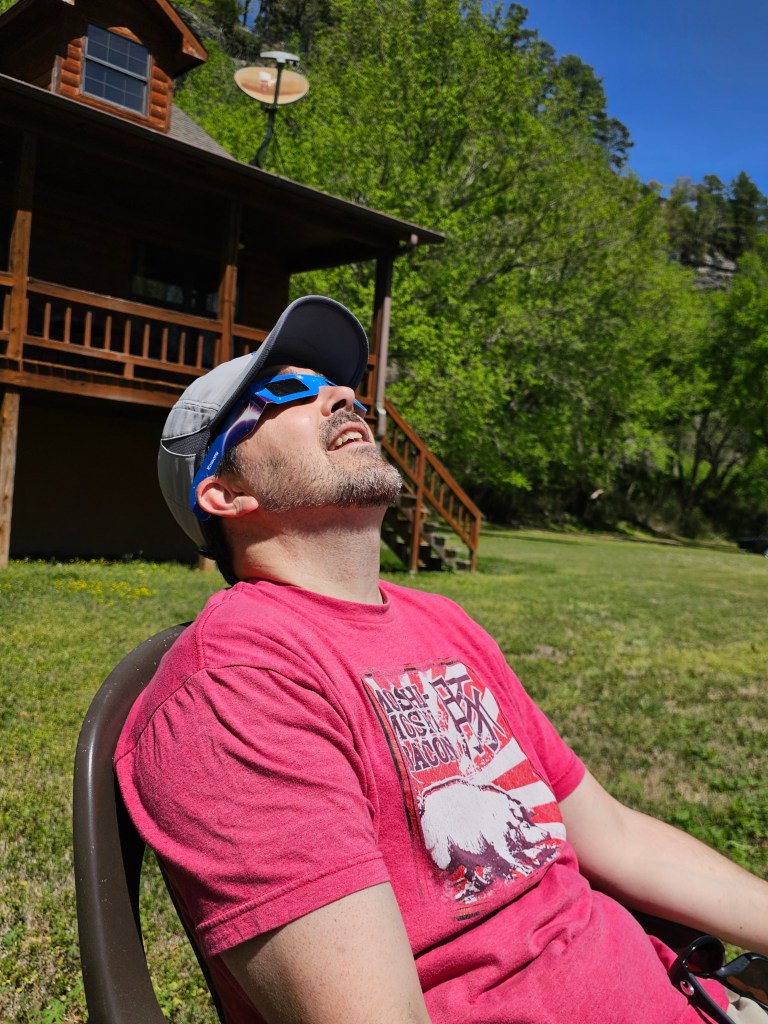
There had been rumors of possible overcast skies on eclipse day, but the day dawned sunny and gorgeous. We enjoyed a lazy morning, walked hakelev and settled in on the porch to wait for the big event. A great blue heron and a pair of bald eagles kept us entertained, and my hubs discovered the nest of an eastern phoebe just beneath the deck.

And God’s mercy continued. The sky remained devoid of clouds. I was beyond thrilled at the chance to see a total solar eclipse, enjoying the cool air and the unusual hush of the birds and insects.

After the main event, all of us (sans pooch) walked back to town and made a proper visit to the “speakeasy” that saved us all from certain hangriness late Saturday night. We bypassed the entrance to Fricki’s Attic and entered Juniper’s Back Door where we enjoyed a delicious late lunch in their eclectic dining area. In the photo, you can see the stage where live music is played on weekend nights.

The rest of the day was relaxing on the back porch, drinking in the views, and feeling gratitude that all the preparation, money, and time spent were not for nothing. I was delighted with Calico Rock and everything about the trip. Even more, I was beyond thankful for a God who doesn’t leave me stewing in my own bitter thoughts but who gently reminds me that I am the one who drifts away; He never does.

I enjoyed the last sunset at our lovely getaway cabin in Calico Rock before preparing to pack up and leave the next morning.

The day came to head home. One hour into our 6.5-hour drive home, we were hit at an intersection as my husband turned onto one of our many interchanges heading home. Once again, God’s mercy spilled out all over us.

The young man who hit us parked and walked across the busy highway, very apologetic and completely taking responsibility for his part in the accident – a very pleasant surprise. Before he’d spoken more than a handful of words, an officer who had been passing by was on the scene with his lights on, keeping traffic at bay.

No one was hurt, for which I am incredibly thankful.

In no time, our car was loaded onto a tow truck. My husband went with the tow guy who offered him a lift to a local car rental place. Meanwhile, the officer gave me and pooch a lift to a safer place to wait while another part-time fireman and part-time youth pastor gave Mama a ride to the same spot.

The officer and I may have had a little too much fun with the dog in the back of the squad car…

Our vehicle, unfortunately, is not drivable.

Now, one might imagine finding a rental car to get three adults, a 65-pound dog, and all our luggage back to Tennessee in the middle of nowhere would be a hard ask. I suppose it is, but not for my God – who, by the way, had mercy on me despite my self focused complaints on our first morning away. The whole delay took less than four hours, including a stop for lunch. Plus, everyone was so kind, we felt nothing more than mildly inconvenienced.

Of course, my husband and I will continue to be mildly inconvenienced for about a month of car sharing. We’ll be dealing with insurance and the like over the phone, and when the repairs have been made, we have a trip to Batesville, AR to plan. But at least we know God will be with us then, too.

And the dog? He thought this last leg of our journey was the best trip ever. Five and a half hours of cuddle time? Yes, please!

So believer, if you are weary, discouraged, or just plain sick of waiting on God, don’t forget that His timing is perfect. And look for small, everyday mercies while you wait. I guarantee you’ll find more than enough to fill your heart with joy.

O Lord, hear my voice! 
Let your ears be attentive to the voice of my pleas for mercy!
If you, O LORD, should mark iniquities, O Lord, who could stand?
But with you there is forgiveness, that you may be feared.
I wait for the LORD, my soul waits, and in his word I hope;
my soul waits for the Lord more than watchmen for the morning, more than watchmen for the morning.
(Psalms 130:2-6)